

Authentic Leadership matters
Authentic leadership is a destination that delivers for male leaders.
But most men were never given the road to get there.
There's an awkward admission buried in the academic literature on authentic leadership.
After two decades of research, hundreds of studies, and enough peer-reviewed papers to fill a library shelf, the scholars themselves concede that the field has a problem:
it's very good at proving that authentic leadership matters, and almost silent on how you actually develop it.
Gardner and colleagues' landmark review of 91 authentic leadership publications puts it plainly. The majority of work to date has been theoretical, building and extending models of what authentic leadership is. Empirical studies that test those models in the real world are the minority. Research that focuses specifically on developing authentic leaders? Rarer still. As the authors note, intervention strategies intended to foster authentic leadership development remain largely unevaluated.
This isn't a small gap. It's the gap between knowing a destination exists and having a road or map to get there.
The evidence for why this matters is substantial enough that it deserves more than a passing mention. Across studies reviewed by Gardner and colleagues, authentic leadership has been shown to be positively linked to:
follower trust in leadership,
job satisfaction,
organisational commitment,
work engagement,
job performance,
empowerment,
employee voice,
organisational citizenship behaviour,
performance at the individual, team, and organisational level,
and leader psychological wellbeing.
It is negatively linked to follower burnout and turnover intentions.
These aren't soft relational outcomes, they are the things a rising leader is being measured on. The research also surfaces something less obvious: authentic leaders benefit too.
The contingent self-esteem that comes from performing a version of leadership you don't own, and the psychological cost of sustaining it, is documented.
What the studies describe, is a leader whose people want to stay, work harder, speak up, trust the direction, and follow without being pushed.
That combination doesn't emerge from charisma or authority. According to the research, it emerges from the perception, held consistently by those around the leader, that what they see is real.
What Authentic Leadership (“AL”) actually is
The concept has a surprisingly long genealogy. The word authentic traces to the Greek authento - "to have full power" - and the philosophical tradition that surrounds it, from Socrates' insistence that the unexamined life is not worth living to Aristotle's conception of eudaimonia, a form of wellbeing that arises not from pleasure-seeking but from performing activities that reflect one's true calling.
Erickson (1995) cautions that authenticity should not be conceived as an either/or condition, since people are never completely authentic or inauthentic. Thus, it is more realistic to describe a person as being more or less authentic.
There are many definitions for authenticity that come at it from different angles…
Harter (2002) describes authenticity as owning one’s personal experiences, including one’s thoughts, emotions, needs, desires, or beliefs which involves self-awareness and acting in accord with one’s true self by expressing what one genuinely thinks and believes (Luthans & Avolio, 2003).
The work that has been most instrumental in reigniting scholarly interest in AL is Luthans and Avolio’s conceptualization of AL and its development. As these authors explain, the theoretical underpinnings of their AL model include positive organizational behavior (“POB”) (Luthans, 2002), transformational/full-range leadership (Avolio, 1999), and ethical perspective-taking (Kegan, 1982). Because of this confluence of perspectives, their definition of AL includes POB states such as confidence, hope, optimism, and resilience (“CHOR”) that later became the basis for Luthans’ and associates psychological capital (“PsyCap”) construct.
Modern scholarship took these and wider philosophical heritages and looked to operationalise it…
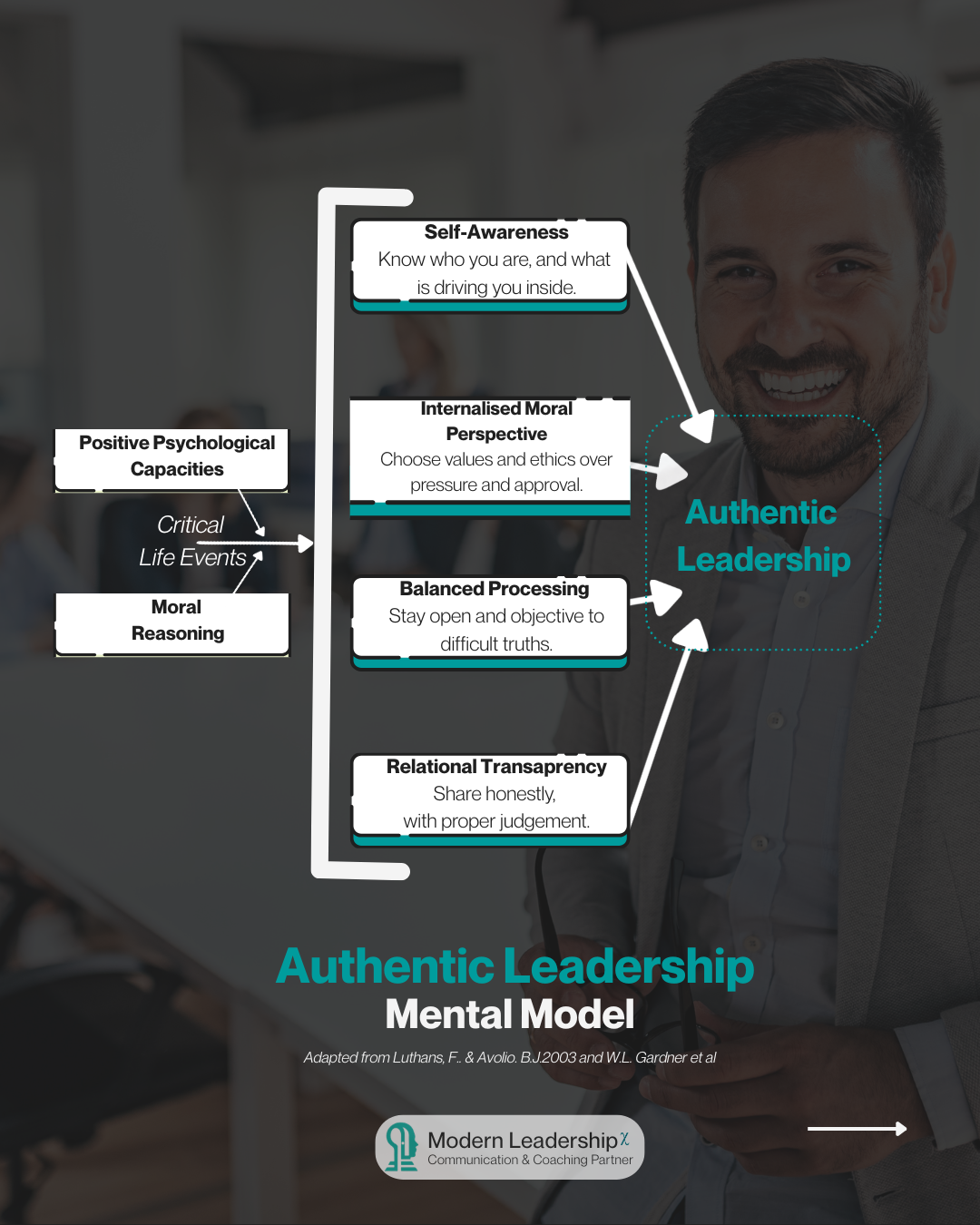
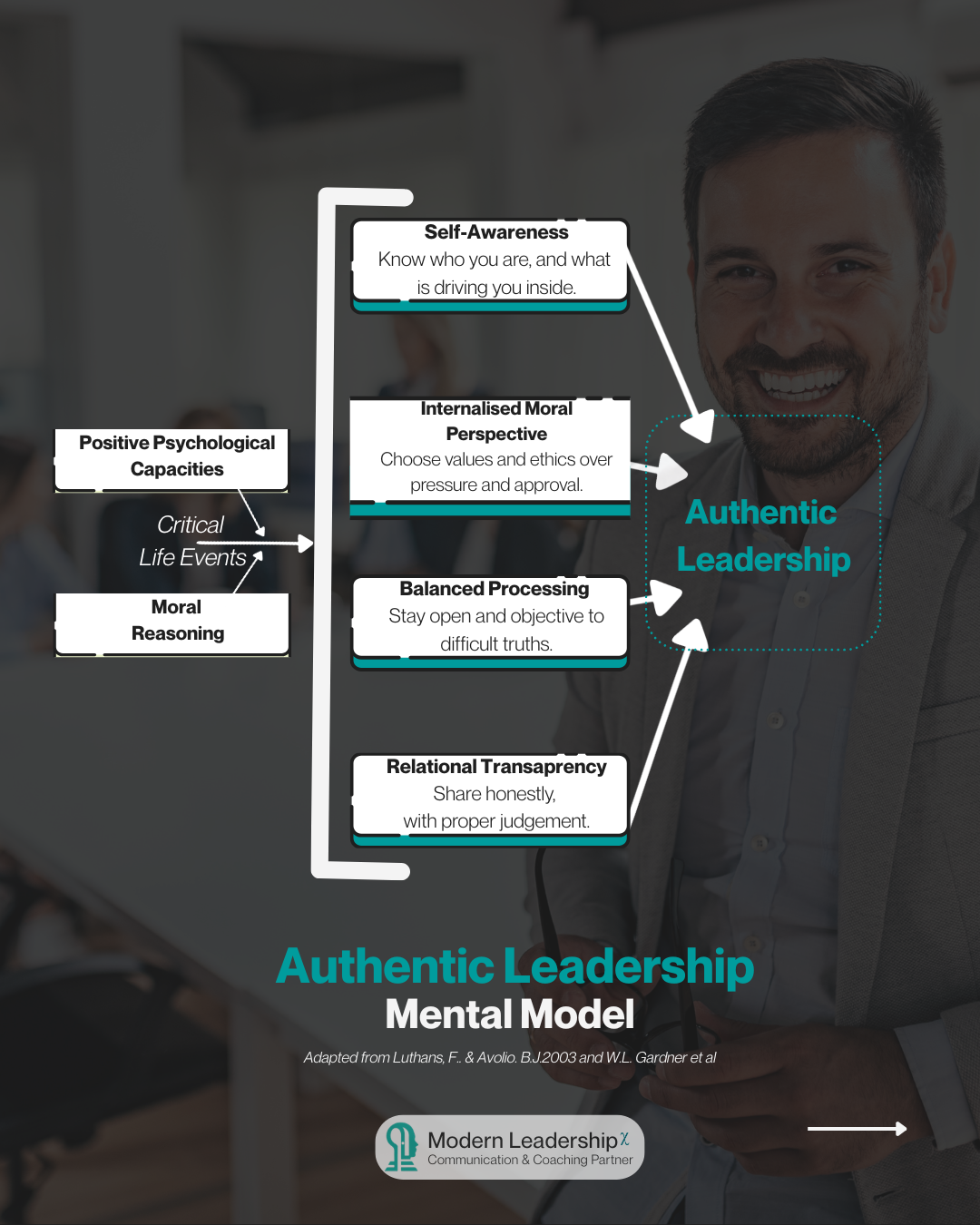
The most widely cited and empirically validated definition comes from Walumbwa and colleagues (2008), as refined through Gardner's sustained research programme serving as a theoretical foundation for several theories of AL:
“Authentic leadership is a pattern of leader behavior that promotes greater:
a) self-awareness
(self knowledge and understanding i.e. knowledge and trust in one’s thoughts, feelings, motives and values);
b) an internalized moral perspective
(the behaviour/action component i.e. reflecting the leader’s commitment to core ethical values, internalized regulation and a positive moral perspective. Acting based on one’s true preferences, values, and needs rather than merely acting to please others, secure rewards, or avoid punishments);
c) balanced processing of information
(unbiased processing i.e. objectivity about and acceptance of one’s positive and negative attributes);
d) relational transparency on the part of leaders working with followers.
(interpersonal relationship orientation i.e. achieving and valuing truthfulness and openness in one's close relationships; Kernis, 2003;)”
In plain English:
Know yourself.
Know what you stand for.
Process information fairly, especially when it threatens your ego (don’t get defensive!).
Let people see enough of the real you to build trust.
The original Walumbwa definition included references to "positive psychological capacities" and "a positive ethical climate" as conditions the behaviour "draws upon and promotes." Gardner's 2021 recommendation was to strip those phrases out, because positing antecedents and consequences inside a definition creates circular reasoning. What's left is cleaner: a description of the behaviour itself, not its preconditions or its outputs.
So four components, and worth unpacking properly…
Self-awareness is not the same as self-consciousness. In Gardner's framework, it refers to knowledge and trust in one's own motives, goals, values, and emotions, and crucially, the work-related self that gets enacted under the pressures of a role. The self, in this conception, is multi-faceted and dynamic. Leaders have a repertoire of selves across different contexts. Self-awareness is what allows a leader to navigate that repertoire without losing the thread back to their core values.
Relational transparency is not radical self-disclosure. Gardner and colleagues are careful here: it means helping those close to you see both your positive and negative qualities as a basis for genuine trust, while encouraging others to do the same. It also means being transparent about how decisions are made and explained, not performing openness, but actually creating the conditions in which honest exchange is possible. There are legitimate limits. A leader facing an anxious private situation may hold that back during a product launch not because they're being inauthentic, but because doing so serves a higher value: commitment to the organisation's people and direction.
Balanced processing replaces what Kernis originally called "unbiased processing", a deliberate revision, because Gardner's team recognised that all humans are inherently biased. What's being asked for instead is the effort to be objective: staying open to ego-threatening feedback, processing information without defensiveness, actively listening to viewpoints that challenge your own position. Not neutrality, but the sustained attempt to get beyond the distortions of self-interest.
Internalized moral perspective is the most contested of the four. Shamir and Eilam, among others, deliberately avoided including ethics as a component, on the grounds that authentic leadership says nothing about the content of a leader's values. Gardner's response: that's precisely the problem. A leader can be consistently true to values that are harmful. Ethics lies at the heart of leadership because leaders' actions have consequences for others, and development that doesn't attend to moral growth is incomplete. The internalized part matters, this is regulation from the inside, not compliance with external norms.
Together, the four components work on each other.
Self-awareness gives a leader the material to articulate their values to others compellingly. Relational transparency creates the conditions for genuine exchange. Balanced processing keeps that exchange honest rather than defensive. An internalized moral perspective means value conflicts with followers get navigated, not steamrolled.
The competing AL interpretations
The four-component model is not the only view of authentic leadership. The debate around it is useful.
Shamir and Eilam take a life-stories approach. For them, authentic leaders are “originals, not copies.” They lead from deeply held values they experience as their own, not values imposed from outside. Their authenticity shows through the fit between who they are, what they believe, and how they act. Development happens through reflecting on life events and the meaning leaders make from them.
Alvesson and Einola push back harder. They argue that leadership studies often treat authenticity as if it were a fixed, measurable thing. But for them, authenticity is more personal, contextual and ongoing. It is not a simple journey from “less authentic” to “more authentic.” They also point out something important: leaders do not have one fixed self. They adapt across roles, audiences and situations. Being rigidly “true to yourself” in every context may not be authenticity. It may just be inflexibility.
Gardner and Karam’s response is the most useful middle ground. Authentic leadership does not ask a leader to perform the same version of himself everywhere. It asks him to navigate different situations without violating the core values that run across who he is. That requires real self-knowledge: strengths, weaknesses, values, goals, motives and emotions.
The most important point is this:
Authenticity is not all or nothing.
Leaders are not simply authentic or inauthentic. They become more or less authentic in different moments, under different pressures.
And we can measure it…
Of the available measures, the ALQ (Authentic Leadership Questionnaire) is grounded in the work by Avolio, Gardner, Luthans, May, Walumbwa et al 2008, and their perspective of AL, which is in turn derived from Kernis and Goldman’s (2006) multi-component conception of authenticity.
This is the most frequently-used measure of AL, while Kernis and Goldman’s Authenticity Inventory (AI: 3) is also available, although this instrument is designed to measure individual authenticity, as opposed to AL.
But this still leaves a practical question:
How does a leader actually get there…?
The Road: how we become an authentic leader
Here is where the literature is most honest about its own limits.
The research has mapped the destination in detail. It has measured the outcomes, validated the instruments, and built the nomological network. What it hasn't done is crack the development question. The authentic leadership literature gives us a strong direction.
It points towards leaders who are more self-aware, morally grounded, open to information, and transparent in relationship with followers. It also links authentic leadership with important outcomes such as trust, engagement, well-being and performance.
However, most male leaders do not struggle because they disagree with the destination.
They struggle because nobody taught them the road.
A man may know his values, but still avoid speaking up.
He may care deeply, but still come across as distant.
He may want to be transparent, but either overshares or says nothing.
He may want to listen, but becomes defensive when challenged.
He may want to lead with integrity, but under pressure defaults to control, performance, approval-seeking or silence.
That is not always a values problem. Often, it is an expression problem.
What the theory does offer are the building blocks…
Authentic leadership, in Gardner's developmental framework, is not a state you arrive at through a course or a retreat. It emerges from a combination of:
personal history - and the meanings a leader attaches to formative events;
trigger events - experiences that provoke self-reflection and interrupt habitual patterns;
psychological capacity - including hope, resilience, optimism, and confidence/self-efficacy (CHOR).
These aren't decorative qualities. They are what allows a leader to stay curious about themselves when self-reflection is uncomfortable, and to stay grounded under pressure rather than defaulting to role.
There is also an organisational dimension. The research is clear that the ethical climate of an organisation either facilitates or undermines the development of authentic leaders and followers. Context matters. A leader striving for authenticity in an environment that punishes genuine expression will obviously face a genuinely harder task than one operating in a culture that values it, and the research supports the view that moving to a different context is sometimes the right call.
But there is also something that context cannot substitute for: the inner work.
This appears to be difficult to reduce to observable behaviours or survey scores. Becoming more authentic in your leadership requires, at minimum:
honest self-examination of the values and motives that actually drive you (not the ones you'd prefer to claim),
the pattern recognition to notice when pressure causes you to abandon them,
and a structured process for integrating who you are into how you lead. Not in safe conditions, but in the moments that count.
The research calls this the gap between felt authenticity and enacted authenticity.
It is real, it is documented, and after two decades of serious scholarly attention, it remains the part of authentic leadership that theory alone cannot bridge just yet.
What this means for a rising male leader
The leaders I work with have usually done the reading. They understand, intellectually, that leading from who they are matters. Some have completed 360s, done the assessments, reflected on their values in a quiet room.
And then one or more high-stakes moments arrive - a difficult conversation, a boardroom, a moment where the environment expects them to perform a version of leadership they recognise but don't quite inhabit - and something shifts. The self they know goes quiet. The mask wearing role takes over. They come out the other side saying that wasn't me and not quite knowing how it happened.
But how do we reliably prevent it?
That, as Gardner's own work concludes, is the work that remains. The science shows it's worth doing. And I’m on a Mission to help us get there…
Here’s a starter for 10:
4 Practices that make authentic leadership real
The academic model gives us four pillars of authentic leadership, and so here’s a question for each pillar you can ask yourself in the moment:
Self-awareness Know what is happening inside you.
Question: What is really going on in me right now?
Internalised moral perspective Choose from values, not pressure.
Question: What would integrity ask of me here?
Balanced processing Stay open to uncomfortable truth.
Question: What might be true, even if I don’t like it?
Relational transparency Express where you stand when it matters.
Question: What needs to be said honestly, but cleanly in a way that lands?
Conclusion
The Psychologist Maslow’s made the point that people are not at peace when they bury what they are here to become.
The same is true in leadership.
A man who is capable of leading cannot fully settle for performing the role while hiding the person that they really are.
Authentic leadership asks him to lead in a way that honours his values, beliefs, strengths and weaknesses. Not as a polished act or a perfect persona, but as a real pattern of behaviour others can experience and trust.
That is where the Expression Gap matters.
Because many male leaders DO know who they are.
They know what they value.
They know what they believe.
They know what needs to be said.
They know the kind of leader they want to become.
But under pressure, the role takes over.
They go guarded, silent, defensive, polished etc.
They perform leadership instead of expressing it.
Authentic leadership gives us the destination:
Self-awareness, moral grounding, balanced thinking and relational transparency.
Our Expression Gaps are the map, with role models that are authentic leaders providing a rough direction to our destination.
Deeper connection with your own authentic leadership is the true destination.
Mastering expression is the road…
To become a leader whose people want to stay, work harder, speak up, trust the direction, and follow without being pushed.
Know yourself.Choose from values.Stay open to truth.Express with integrity.
#leadership #authenticleadership #authenticity #leader
Morgan works with rising male leaders on identity awareness and self-expression - helping them close the gap between who they are and how they show up when stakes are high.
References:
2011 Yearly Review: The Leadership Quarterly: ‘Authentic Leadership: A Review of the Literature and Research Agenda’ (William L. Gardner et al.)
Authentic leadership theory: The case for and against (Gardner Letter responses to critique)
Medtronic CEO Bill George (Authentic Leadership, True North, George and Sims, 2007)
Authenticity: the often missing link in modern male leadership.
“To thine own self be true, and it must follow, as the night the day, thou cans’t not be false to any man.” —Shakespeare, Hamlet
We hear it everywhere: “Be yourself.” “Be authentic.” “Speak your truth.”
- let’s face it, it can be the most useless ‘advice’ anyone can receive, in isolation that is.
But very few people actually understand what authenticity is, and its relationship to self-expression. In not understanding this, it will only hinder attempts for the modern man to develop into their own most integrated, powerful and full expressed self as a man and a leader, to serve others, have maximum healthy impact and tap into their full potential.
The real problem is not that men lack authenticity, it’s that authenticity remains trapped internally, unable to be expressed.
Authenticity vs. Self-expression
Authenticity and self-expression are deeply connected, but they are not identical.
Authenticity = Alignment with the “true self”
It refers to the degree to which a particular behavior is congruent (in agreement or harmony) with a person’s attitudes, beliefs, values, motives, and other dispositions.
Self-expression = Enactment and communication of that true self
Self-expression is the behavioural mechanism that reveals how aligned you are to your authentic self.
Research consistently supports this self-congruency principle. When individuals behave in ways that align with their true self-concept, they experience authenticity. When behaviour contradicts their self-concept, they experience inauthenticity*.
Authenticity is not just a belief, it is a lived behavioural state.
[Trying to] Define Authenticity
As the term is typically used, authenticity refers to the degree to which a particular behavior is congruent with a person’s attitudes, beliefs, values, motives, and other dispositions.
However, researchers disagree regarding the best way to conceptualize and measure authenticity, whether being authentic is always desirable, why people are motivated to be authentic, and the nature of the relationship between authenticity and psychological well-being.
There are 4 broad categories of authenticity as a field:
Self-congruence (internal psychological alignment angle)
At the core of authenticity research is something called self-congruency.
This is further broken down into different self-congruence concepts such as:
Congruence with the “true self” inner identity- a person’s “actual physiological states, emotions, and beliefs” (Wood, Linley et al) e.g. “I was my true self during the last 10 minutes”
Congruence with beliefs, attitudes, or values (which can, but not always, result in integrity when acting in accordance with our values or morals)
Cross-cultural and cross-role consistency (the degree to which people’s behavior varies across situations or social roles) - There is an assumption that people who act congruently with how they really are necessarily demonstrate greater consistency across situations, although this is not always the case.
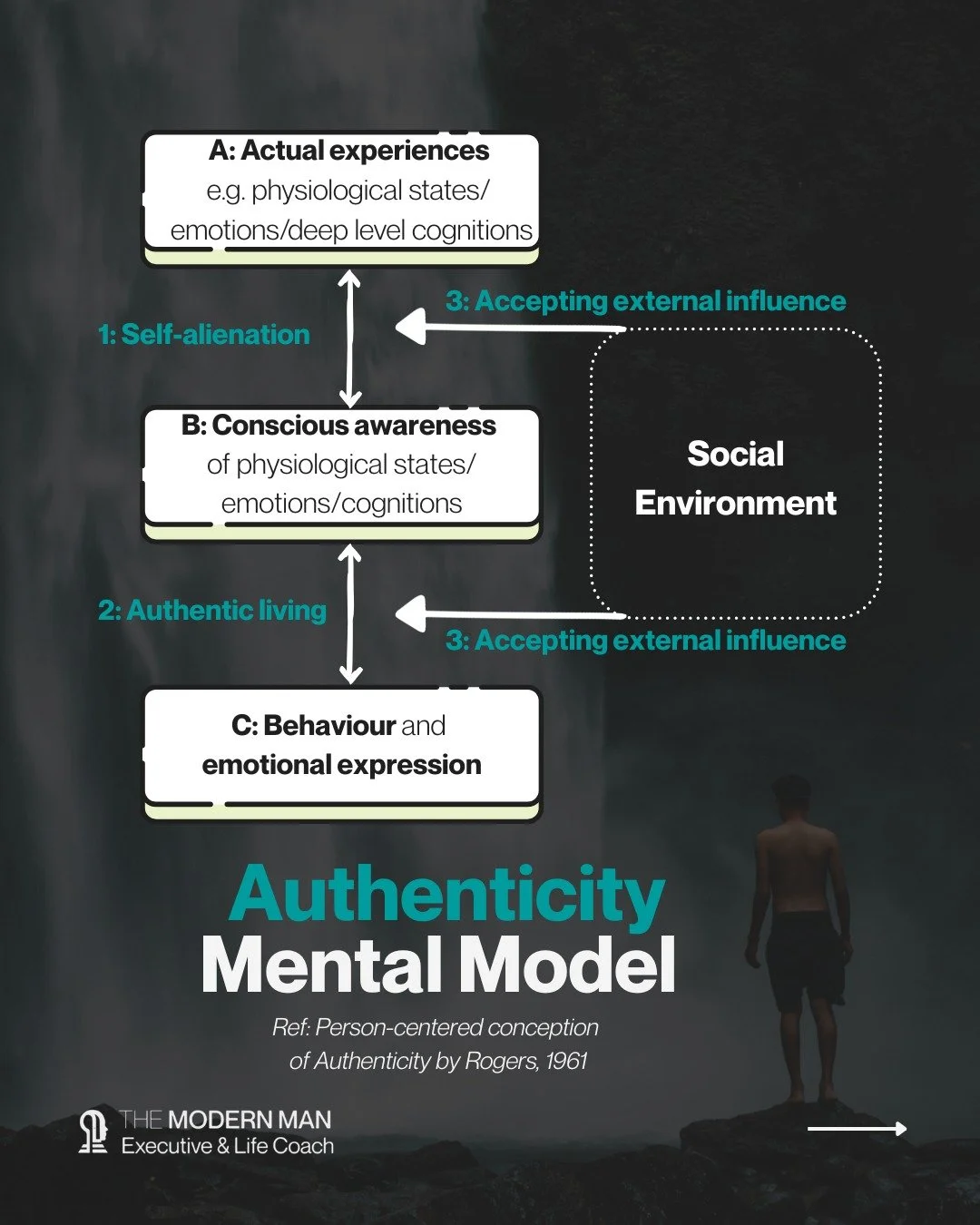
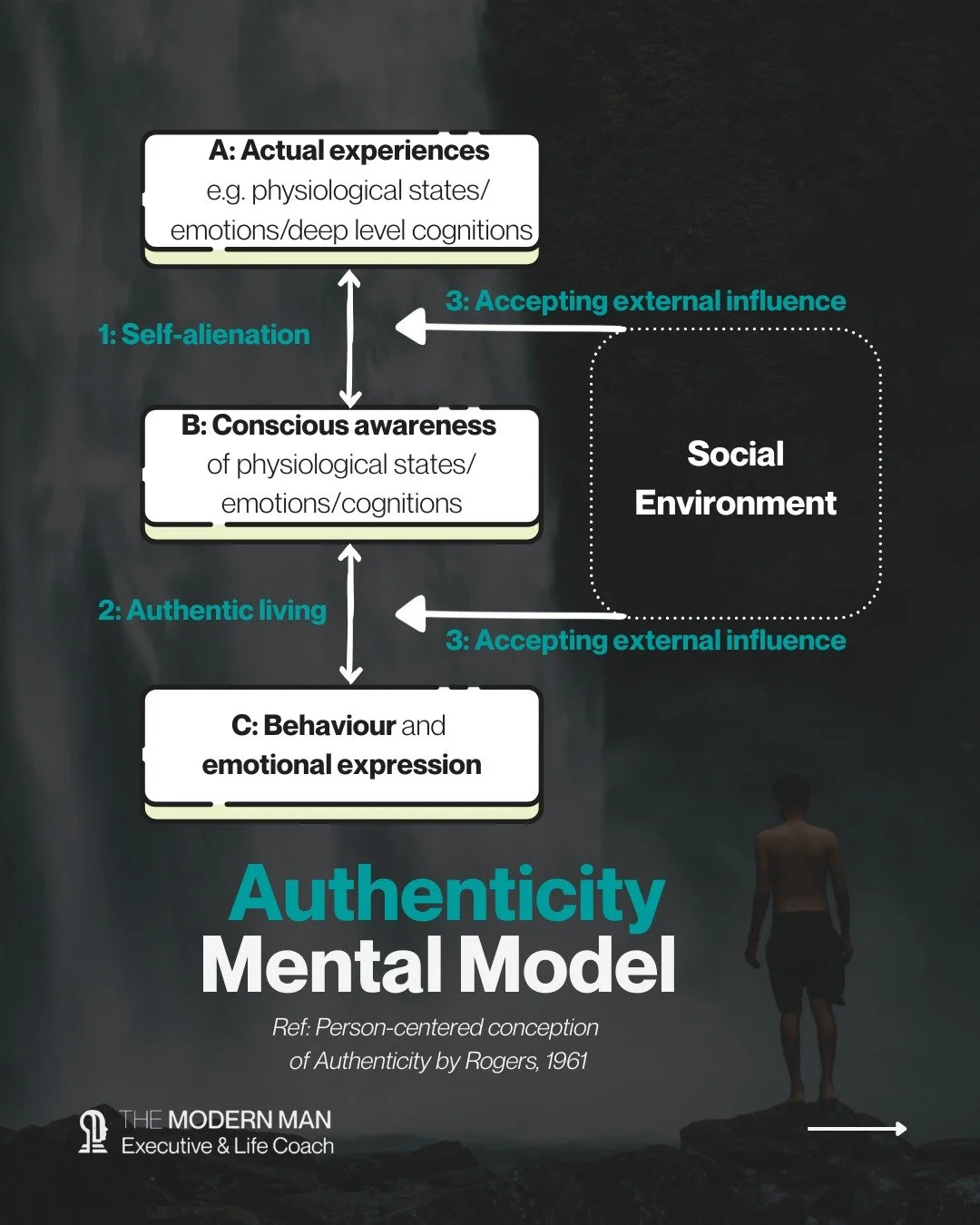
2. Person-centered approach (the human and social angle - see figure below)
Born out of therapeutic evidence that individuals progressed better when: responding authentically, distancing themselves from societal expectations, letting go of externally motivated goals, and revealing their true selves to close others*.
Maslow (1971) suggested that, to be authentic, people must discover their true identity, allow their behavior to be a true and spontaneous expression of their feelings, and live in a way that expresses their actual characteristics and desires.
The person-centered approach was advanced upon by Barrett-Lennard (1998), suggesting that authenticity involves congruence among three components of psychological functioning:
internal experience
awareness of experience
external behavior.
The more that people are aware of their inner experiences and then behave in ways that are congruent with those experiences, the more authentic they are. Like Rogers (1959), Barrett-Lennard argued that people are authentic when their internal experience and behavior are free of outside influences and other people’s expectations.
3. Intrinsically Motivated Behavior (the inner motive angle)
According to self-determination theory, human beings inherently value acting congruently with their intrinsic motives but differ in the degree to which they actually do so (Ryan, 1995; Ryan & Deci, 2004). The theory maintains that the most autonomous or authentic source of motivation is intrinsic motivation—a desire to engage in behaviors because they are inherently enjoyable or interesting.
The theory states that people are most authentic when they are intrinsically motivated.
From the self-determination perspective, authenticity can be assessed by determining the degree to which people choose to behave in a particular way for intrinsic reasons rather than because of external pressures.
This is contrasted with 4 types of extrinsic motivation:
external regulated behaviour (due to external incentives only)
introjected regulation of behaviour (enactment to protect one’s ego and avoid negative emotions without internalising the behaviour as part of one’s self concept)
regulation through identification (consciously placing personal importance on a goal even though the reasons for pursuing it are external)
integrated regulation (when a goal is completely integrated with one’s self concept but is not intrinsically motivating or interesting)*.
4. Subjective Feelings of Authenticity (the experiential/felt angle)
Researchers sometimes conceptualize authenticity experientially, focusing on people’s subjective feelings of self-congruence or authenticity.
e.g. describing a past event during which they felt most like their true or real self, how often then feel they are themselves or not etc.
Whichever conceptualisation you favour, when your actions contradict your internal identity, you experience fragmentation.
Hence why authenticity feels like relief, and inauthenticity feels like tension. It reflects a real psychological conflict between internal identity and external behaviour.
Cognitive consistency theory explains this well. Humans are driven to maintain alignment between beliefs, identity, and behaviour. When these become misaligned, psychological discomfort emerges*.
In other words, authenticity is psychological coherence. Self-expression is how coherence is achieved.
Subjective feelings of one’s authenticity and inauthenticity are an interesting and potentially important phenomenon in their own right, but such feelings do not necessarily reflect how authentic people actually are. People quite often just don’t know what they are like, or why they do what they do (Bargh et al.).
Some scholars have disputed that people possess a “true self” at all, although most agree that people’s beliefs about the true self are important for finding fulfillment and meaning in life. The human personality has a myriad of personality dispositions, emotional tendencies, values, attitudes, beliefs, and motives that are often contradictory and incompatible even though they are genuine.
In fact, Fleeson studied this in 2004, and found that intrapersonal variability on many traits is as great as the variability observed across people . Two seemingly incompatible actions might both be highly self-congruent. People are simply too complex, multifaceted, and often conflicted for the concept of a unitary true self to be a useful standard for assessing authenticity, either in oneself or in others (James, 1890)*.
Authenticity isn’t just behaviour, it’s a Psychological System.
Authenticity is not simply “saying what you feel.” It is a deeper psychological process involving multiple components.
Kernis and Goldman’s foundational model identifies four core elements of authentic functioning:
• Self-awareness - to have self-awareness is to possess self-knowledge
• Unbiased self-evaluation (aka. honesty)
• Behaviour aligned with internal values (aka. expressing the self)
• Relational openness and honesty* (aka. relationship transparency)
In order to strive for authenticity and to know whether they are being authentic, people must know what they are actually like.
People usually think that they have a good idea of who they are, what they are like, and why they do what they do, but all indications suggest that people’s self-perceptions are partial, selective, and biased (Vazire & Carlson, 2010). And if people are not and cannot be aware of what causes them to act as they do, then they cannot possibly know whether a particular reaction is “really them.”.
We need to keep in mind that much of what people believe about themselves is incomplete, biased, or untrue (Vazire & Carlson, 2010), so we should not be so confident and sure that an action of ours is or is not congruent with our personal characteristics, attitudes, beliefs, values, and motives.
In the research whitepaper acting as critical study on authenticity entitled: ‘The Enigma of being yourself’, the researchers’ view was that: ‘admonitions to be authentic make sense only if people have full and accurate knowledge about themselves and, thus, know when they are and are not being authentic. Given that people do not have the requisite self-knowledge and feelings cannot be trusted, requiring accurate self-perceptions as a precondition for authenticity is highly problematic.’
Even so, our subjective judgments of our authenticity (“subjective authenticity”) is still an important topic in its own right because people’s emotions and behaviors are affected by their perceptions of their authenticity, whether or not they’re accurate.
Types of Authenticity
Firstly, there are different types of authenticity researched and referenced in the literature. Primarily, state authenticity and dispositional authenticity.
State Authenticity
State authenticity refers to the moment-to-moment feeling of being aligned with one’s true self*.
Disposition (trait) authenticity
Trait authenticity is a stable tendency to behave in ways that align with core values, beliefs and identity across time.
Relational Authenticity
We can also define a third type, called relational authenticity.
This encapsulates the degree to which we are open, honest and congruent within close relationships.
Other types of authenticity and related descriptors are sometimes referenced such as existential authenticity (living in alignment with freely chosen values despite social pressure), behavioural authenticity (which is more embedded in self congruence frameworks as opposed to a distinct type), perceived authenticity (how authentic others perceive someone) and moral authenticity (where research distinguishes between authenticity and integrity, given someone can be authentic and lack integrity and vice versa).
Authenticity isn’t fixed, it’s a dynamic state.
Authenticity is not a permanent trait, it fluctuates depending on context and behaviour.
You can feel authentic in one environment, and inauthentic in another. This explains why many men feel fully themselves with close friends, but restricted at work.
It is not because their authentic self disappears. It is because the conditions required for authentic expression are absent.
People assume authenticity is consistency in that people who behave congruently with how they really are naturally behave quite similarly across situations and roles. Yet, equating consistency with authenticity is based on one of two unfounded assumptions:
either people have a monolithic, internally consistent personality - Unlikely!
or they possess a psychological mechanism that somehow coordinates all of their actions to render them consistent. That would be nice!
Behaviour has a large amount of variability and inconsistency and is situation dependent. Behaving inconsistently does not imply people are not behaving congruently with how they really are. In fact, behavior to meet situational demands (often called “functional flexibility”) is, within limits, psychologically and socially adaptive and that behavioral invariance can be a sign of maladaptive inflexibility (Funder & Colvin, 1991).
One area of my coaching work focuses on supporting male leaders to express themselves consistently with who they are in that moment through creating safe containers and environments, as opposed to assuming a fixed inner identity that they must consistently remind themselves of and align with no matter when or where, as well as supporting them in aligning with who they believe they are and want to become as trait authenticity. Coaching at a state of being can have the greatest transformation impact over other forms such as transactional (goal-based) coaching which is quickly becoming handled by AI personal coaches.
But here’s the bottom line…
Authenticity depends on expression > Expression depends on safety > Safety depends on environment.
This is where most relational and leadership environments fail.
Authenticity does not require perfect consistency, at its root it requires honesty. Authenticity is not about being one thing all the time, it is about not pretending to be something you are not.
Authenticity is not perfection, it is alignment - whether in the present or as a reflection of overall identity of who you are and want to be.
To explain it another way, I’d like to share a concept in Taoism…
They have a concept called Wu Wei (effortless action or non-doing) which signifies aligning actions with the natural flow of life rather than forcing outcomes. By practicing Wu Wei, individuals can align themselves with the natural rhythms of the universe and find harmony in their actions.
It’s about finding equilibrium when it is lost. It is about being still in motion, accepting change, and living simply. By embracing these principles, individuals can move from one balance point to the next, fostering a deeper sense of tranquility amidst life's complexities.
And we can now measure it.
In The Authentic Personality: A Theoretical and Empirical Conceptualization, researchers set out to develop a reliable Authenticity Scale as a measure of dispositional trait authenticity and tests whether authenticity is related to well-being, as predicted by several counseling psychology perspectives.
In developing a scale of dispositional authenticity, there was a need for a clear definition of the construct, both for item development and to interpret the existing literature. Fortunately, such a definition emerges from person-centered psychology, where substantial debate and conceptualization has led to a clear explanation of the construct, with consensus on the content and boundaries of authenticity (see Wyatt, 2001). The person-centered model mentioned above defines authenticity as a tripartite construct defined by Barrett-Lennard (1998, p. 82) as involving:
“consistency between the three levels of:
(a) a person’s primary experience
(b) their symbolized awareness
(c) their outward behavior and communication”
The researchers focused on the person-centered definition of authenticity simply because it appears to provide the widest and most comprehensive explanation of the construct. This seems to agree with various counseling, clinical, and empirical perspectives, with each conception of authenticity mapping on one or more of the lines as illustrated in the attached figure below.
Scales were designed to measure the tripartite conception of authenticity, comprising self-alienation, authentic living, and accepting external influence.
The scale demonstrated authenticity was strongly related to self-esteem and aspects of both subjective and psychological well-being. In many mainstream counseling psychology perspectives, authenticity is seen as the most fundamental aspect of well-being (Horney, 1951; May, 1981; Rogers, 1961; Winnicott, 1965; Yalom, 1980). These researchers see authenticity not simply as an aspect or precursor to well-being but rather the very essence of well-being and healthy functioning. As such, departures from authenticity are seen as involving increasing psychopathology.
Self-alienation
The first aspect of authenticity involves the inevitable mismatch between the conscious awareness and actual experience.
Perfect congruence between these aspects of experience is never possible, and the extent to which the person experiences self-alienation between conscious awareness and actual experience (the true self) composes the first aspect of authenticity and leads to psychopathology. The subjective experience of not knowing oneself, or feeling out of touch with the true self, is indicative of this aspect of authenticity.
Focusing on internalizing external influence, particularly during childhood, leads to self-alienation. Selfalienation was in turn seen to be the cause of psychopathology as well as mental distress. Even PTSD has been conceptualised as a shattered inauthentic self, and linked its distress with bringing self-alienation to awareness.
Authentic Living
The second aspect of authenticity involves the congruence between experience as consciously perceived (Box B) and behavior (Box C; Rogers, 1959, 1961). Authentic living involves behaving and expressing emotions in such a way that is consistent with the conscious awareness of physiological states, emotions, beliefs, and cognitions.
In other words, authentic living involves being true to oneself in most situations and living in accordance with one’s values and beliefs.
Social environment: Conscious conformance, and accepting external influence
The third aspect of authenticity involves the extent to which one accepts the influence of other people and the belief that one has to conform to the expectations of others. Humans are fundamentally social beings, and both self-alienation and authentic living are affected by the social environment (Schmid, 2005).
The cost of suppressing self-expression
When authentic self-expression is suppressed, psychological fragmentation emerges.
The internal self and external self diverge creating self-alienation.
Historically, this phenomenon has been described as false-self behaviour, where we can act in ways that conceal one’s true internal experience in order to conform to social expectations.
This is not rare, and in most cases is normalised. It is particularly prevalent among men and male leaders who are under pressure to perform, often.
This can lead to feeling numb, lonely or disconnected and if left unattended result in mental health challenges or worse.
Why this matters
From an early age, men are conditioned to regulate expression.
Be strong. Be composed. Be in control - Do not show weakness.
This conditioning teaches behavioural suppression, not authenticity.
Men learn to manage perception rather than express reality.
Over time, this creates a widening gap between internal identity and external behaviour. This is the Expression Gap.
It is not that men lack depth, It is that expression has been constrained.
The consequence is profound. When leaders cannot express their internal reality, they become psychologically divided.
They operate through performance rather than presence.
They lead through persona rather than self. And people can feel the difference immediately.
Trust is built through authenticity. Authenticity is built through expression.
Expression is built through psychological safety and courage.
Authenticity is often misunderstood as vulnerability alone. It is not. It is structural integrity between your identity and behaviour.
It creates:
• Psychological coherence
• Emotional stability
• Relational trust
• Leadership presence
• Internal clarity
Authenticity reduces internal conflict, increases decisiveness and strengthens leadership.
Because when behaviour aligns with identity, energy is no longer wasted on maintaining masks.
All energy becomes available for creation, leadership, and impact.
Authenticity isn’t found, it’s enacted.
Authenticity is not something you discover once and permanently possess. It is something you enact repeatedly.
Through expression, through behaviour, through choices.
Every moment presents the opportunity to either reinforce or fragment alignment.
Authenticity is not a personality trait, it is a behavioural practice.
In should be noted that, in many ways, authenticity is inevitable. Any intentional and goal-directed behaviour will always reflect some genuine characteristic and therefore have some aspect of authenticity. But we can elevate that to a greater extent.
Behaviours differ in their level of alignment with someone’s characteristics, some more self-congruent (and authentic) than others. The degree to which we are self congruent and authentic as opposed to perceived to be, will always be hard to measure.
The leadership divide
The divide in modern leadership is not between strong and weak leaders. It is between expressed and unexpressed leaders.
The most trusted leaders are not those who perform perfectly, they are those whose internal identity and external behaviour are aligned. They seem composed, real, engaged, and people trust that alignment. They distrust what just seems like performance.
Authenticity signals alignment, self-expression makes it visible.
Final Thought
Contemporary perspectives often assume authenticity is beneficial uniformerly across all areas, without recognizing that behaving congruently with one’s undesirable attitudes, beliefs, values, motives, and other characteristics can be highly problematic.
In order for civilized society to function, people must restrain impulses that might hurt themselves or others no matter how genuine and self-congruent those urges might be.
Authenticity is therefore always a part-mitigated value because we do not want people to behave congruently with their antisocial attitudes, motives, and other characteristics.
Although existing conceptualizations of authenticity are problematic in the ways we described, something like subjective authenticity does seem to exist phenomenologically. People do feel authentic and inauthentic at times. Research suggests that self-rated authenticity is associated with well-being, suggesting that the phenomenon that people call “authenticity” is psychologically meaningful but perhaps misconstrued.
Authenticity begins internally with awareness, getting to know oneself. Self-expression completes it externally.
Without authenticity, expression becomes performance.
Without expression, authenticity becomes trapped potential.
We must be aware of and accept our social environment, find intrinsic motivation and not overly conform to external people or drivers.
Leadership begins at the point where authenticity becomes expressed, and we can master expression as a skill to reap the wellbeing and psychological rewards in building a greater sense of authenticity.
References:
The Enigma of Being Yourself: A Critical Examination of the Concept of Authenticity. Katrina P. Jongman-Sereno and Mark R. Leary
The Authentic Personality: A Theoretical and Empirical Conceptualization and the Development of the Authenticity Scale
MULTICOMPONENT CONCEPTUALIZATION OF AUTHENTICITY: THEORY AND RESEARCH Michael H. Kernis, Brian M. Goldman
Refining the self-congruency hypothesis of state authenticity: A self-threat model. Carolin Huber
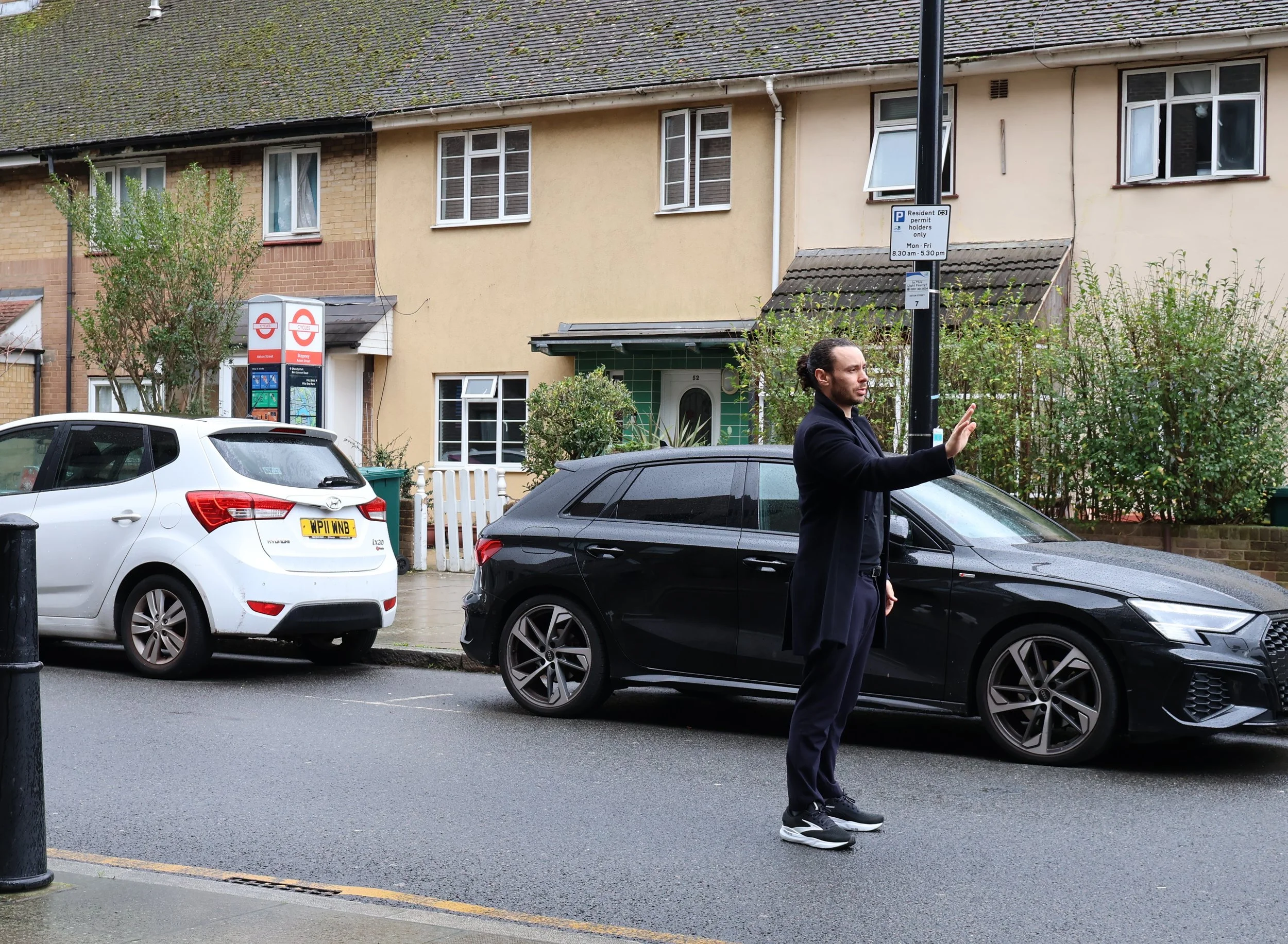
The Man in the Road - my story, and the factors conditioning men to live small
This is a very personal sharing about my story, how I went from being a shy, playful little village boy, to learning to disappear, to breaking down, to fighting his way back to becoming a man willing to stand in the middle of the road, calm, present, and unflinching, even when others disapproved.
It's been hard to write, but I guess embarrassment is the price of entry.
For those willing to give the time to read it, I hope there is some inspiration in there, especially if you are someone feeling a little disconnected, anxious, burnout, lost or lonely as a leader or in your personal life.
It’s some of my story, a story about leadership, particularly self-leadership, and the long winding journey to guiding myself back home with some much needed support.
My Story
I grew up in a small village in the Brecon Beacons, now returned to its proper Welsh name Bannau Brycheiniog National Park, in South Wales, UK. In our case, think lower middle class, with a quiet and beautiful countryside backdrop. Isolated, but charming in its own way. I enjoyed my childhood, I was fortunate in many ways, my parents were loving and instilled a strong work ethic.
As a kid, I was shy, timid, playful, and deeply curious. I wanted to understand everything. I asked a lot of questions, A LOT. I explored, got distracted easily judging by old school reports, hid behind my mum’s legs when meeting strangers etc.
Something wasn’t quite right. In retrospect I was quite nervous, watchful, self-monitoring before I even had words for it.
There was a sense I never quite felt enough, but again before I had words for it. I didn’t trust my own judgment, and neither did my father.
There’s a moment that sums this up. I was once asked to trim the Jasmine creepers around the facia of the house, with explicit instruction NOT TO GO NEAR THE POWER CABLE. Naturally, I sliced straight through that beauty like butter with my secateurs. A live power line while standing on top of a tall ladder. When my dad ran out the sparks were still gracefully falling from the sky like a cascade around me as he saw what I’d done, he just gasped, “How are you still alive?”. I wasn’t reckless. I was disconnected from my own sense of consequence and self-trust.
At school, I was sometimes bullied for my curly hair. Other times challenged for trying to walk with the “cool” group with the occasional punch or squaring up in school corridors completely unprovoked. I learned quickly how fragile belonging was.
So I adapted.
I became a people-pleaser, a skillful one I might add. I exaggerated stories (albeit less skillfully in that case), I tried to be funny, I learned how to charm, distract, smooth things over. Looking back, I don’t see that as weakness so much, more protection. A nervous system doing what it needed to survive socially.
There was a lot of pent up restless energy. I learned to channel this into learning, instruments, gaming, pranking around the town, working out, reading physics and magic trick books, football, dabbling in martial arts. I loved effort, didn’t love conflict and avoided fights. I ran away when things escalated, literally or figuratively. Only stepping in if a good friend or stranger was in real danger and I felt I could help.
Later, some of that same pattern showed up in intimacy. I became overly timid, unsure and distinctly lacking confidence.
I wasn’t diagnosed with ADHD or anything like that although perhaps I would’ve met the criteria. I was mischievous, distracted, and immature compared to others, especially the girls in my class. They seemed composed, organised, ready for the world. School felt like a playground to me. That came back to bite me at university, but before leaving my parents decided to split-up which felt upsetting and destabilising. I didn't have a great deal of time to process what it all meant before one month later hopping on the train to university itself.
When I kicked-off my time at the redbrick University of Bristol to study physics, I realised I had no idea how to truly study hard. Friends who’d gone to private school smashed it. I struggled through, not because I was stupid (despite any fair reasoned judgements after hearing my cable cutting antics), I just wasn’t ready. I just couldn’t compete on many levels and, to a degree, fit in easily either.
Neither during my upbringing nor in High School did they teach about how to process emotions, know your self-worth or how to express yourself without needing external validation. There was no manual for how to handle yourself under pressure. As a boy, on a few occasions I would aggravate a friend without realising it, and on two occasions got punched in the jaw. Deservedly, I suspect. I didn’t know how to hold my ground without provoking or withdrawing. That said, during university I did manage to meet some new friends, good friends still to this day.
At home, things were complicated.
My mother downsized and lived with my sister, she was (and still is) warm, kind, compassionate. A former teacher and careers advisor who was always emotionally available. She struggled historically with money and self-esteem, partly due to regular put-downs from my father which I'm sure he would admit to, who was only repeating patterns from his own upbringing.
My father was a world-leading cave diving explorer. Brave. Focused. Driven. But he had picked up his own fair share of deep and painful scars. I recall spending an evening with him and his best friend when 13 years old, who helped to install that 'man stranded on a desert island' screensaver if anyone remembers that. The next day, I was picking up the phone to the sound of dad in tears, repeatedly asking me to pass the phone to mum. That day his best friend Pete had drowned right in front of him, and I can still hear the pain in his voice today, That was one of several that would occur as the years went by. His sister, my auntie, suddenly passed away from pancreatic cancer within months, which he then shielded me from seeing in her final days to my sad disappointment. I'm sure it was for my own good, but it was hard to accept and process, as I wanted to say goodbye. My father was emotionally unavailable and not quite as present as I grew older in those teenage years. He had a temper, and could be quite physically threatening to me as a boy and teenager. Whilst this is of course not acceptable today, I don’t judge him for that as that’s exactly how his parents brought him up (in fact he had it much worse). He once chased me through the house, and down our long garden for mildly misbehaving, and I had to leap over a bush into a country road to escape. I laughed about it back then. Looking back, I don’t think any of this should be accepted as normal.
What it did do was teach me fear. And fear made me armour up. I found the gym, and with it strength and size. At 16, I was no longer controllable. I could calmly stand my ground and he knew and felt that. The balance of power had rebalanced somewhat.
Despite what I’ve just said, it is more important to note that my father had many more positive qualities that surpassed this and guided me too, that I'd want us to focus on. He pushed my sister and I ‘to be the best in the world’, and to work really hard to compete with the rest of the world. My mother used to supplement (or should I say… counter) that by saying ‘be the best YOU can be’. He was a very high bar to compare ourselves too, a source of not feeling ‘enough’ no doubt.. He tried to motivate through external rewards. £1000 if I reached Grade 8 piano - FAILED, £1000 if I didn’t smoke by 18 - FAILED. It didn’t work for me, but worked for my sister. I was always much more intrinsically motivated, I did what I wanted. I quit piano at a low level Grade 6 when 16, then returned almost 20 years later on my own terms and achieved Grade 8 Distinction, paid for by myself.
But he taught me something else, something far more powerful and meaningful, without words.
One day in a local town Abergavenny, we were walking down the pavement together and saw an elderly woman at a distance waiting to cross for what seemed like forever. No cars were stopping, and she still stood politely as she propped up her mobility shopping case next to her. Unannounced and seemingly out of nowhere, my father calmly stepped straight into the busy road, raised his hand to the oncoming car who did need to apply emergency brakes, and unashamedly stopped the traffic. He just stood still, completely unreactive, as he helped escort her across while a man in the stationary car gestured, swore and beeped angrily, then proceeded to walk back and join me. The old lady waved and said thank you from the other side. We never discussed it.
That moment stayed with me.
Do the right thing. Even if people judge you.
That was leadership expression, with integrity.
I rejected parts of myself growing up. The fighter. The assertive masculine side. It didn’t feel safe with my father or my peers. I doubted my worth, which projected into everything.
I recall climbing a tree with a good friend in my teenage years, and slipping and falling 15-20 feet onto my back into a muddy field. At first I couldn't get up, and became petrified, thinking the worst. But managed to hobble up, with immense back pain which my friend asked me to hide when we returned to his grand parents house we were staying at. It was excruciating, and the lower back pains continue to this day. To add to that classic boyhood macho 'don't show weakness' theme, a year or two later I was playing football and holding my back as it was like shooting dagger pains as I jogged around and a friend just shouted at me 'Don't be a P@$y!!'. I was riled by that lack of support, care or sympathy and replied: 'I wish you had it for a second so you knew the pain', I didn't mean it maliciously and more just to angrily express that I wanted some empathy, to walk in my shoes. He was much bigger than I was, an alpha you might say (a great guy for that matter!), and after a briefly threatening confrontation from him in response I just went silent, which was my coping strategy for that moving forwards.
Attraction followed the same pattern. I had some luck with women, despite my shyness, but I repeatedly found myself in relationships with partners who had low self-esteem. I didn’t know how to spot it because I hadn’t faced it within myself.
Relationships became volatile, toxic, emotionally damaging. More than one partner threatened to take their life. I confess, and not for the sake of dramatised vulnerability, attention or otherwise that I did suffer some physical domestic abuse, narcissistic and coercive control and certainly picked up my fair share of emotional scars back then. My nervous system was on fire for years. Panic attacks, an anxiety disorder, relentless performance anxiety, tension in my body, difficulty focusing etc. I suffered from burnout in work, digestive issues, so many things building up.
I never became suicidal, but I worried daily that I might get there if things didn’t change. I found it hard to open up about this although I managed to tell a GP at the time. It was something.
At 21, I broke.
Walking up Park Street in Bristol, I finally accepted I didn’t know how to escape this low feeling after trying so hard for so long, and decided to call my father about it for the first time. As the call was connecting, I felt a flood of tears and just said, “Dad, I’m…. I’m just so fed up.” I couldn’t even finish the sentence. In truth, typing this is bringing back some tears. It was the darkest, loneliest and scariest period of my life so far. Even my closest friends don’t know a lot of the detail.
To my father’s credit, he drove up almost straight away and suggested we talk about it over a pint. That was his language, and it helped. Listening, whilst giving practical advice and his usual bold encouragement - “Come on, you can do it”. I was back running and exercising the next day.
My mum helped incredibly in a different way. We had calm, honest, walks and talks. She was great at listening, gave me suggestions like hot baths to calm those bad days of nerves, encouraged a visit to the Doctors and provided constant meaningful support. I needed that.
I graduated in 2008 during the financial crisis. There was barely any jobs in the market, the degree felt useless. I fell into IT, worked very hard, too hard perhaps. I was promoted five times in quick succession in my first company, from B2B tech sales to programme manager, but emotionally I was a little reactive at times, certainly defensive under pressure. I wanted to impress, to learn, to accomplish, and needed to be seen as capable. The Directors and SLT knew I got the job done, and went above and beyond what most would, it was in my character and was clearly noticed. I recall a government tender the company really wanted to complete but didn’t have either the team nor the time to get it done by the deadline COB the next day. I asked for all the related folders to be dropped on my desk at 5PM, and pulled a 36 hour shift without breaks all alone in the office with A3 paper scattered across the floor, covered in felt tip marks as I methodically designed and planned a rural and city WiFi rollout. I got it delivered by the deadline the next day, a tender that we went on to win. I think I was a handful to those above me back then, but they tolerated and channeled that which I’m very eternally grateful for.
In those early to mid twenties, I poured energy into everything, much like school seen as a playground, this was an adult playground. Gym, learning to DJ, shelf help, triathlon training, partying, hard, often destructively. My social anxiety was brutal, but as we learnt earlier I hid it well. I went one step further though as my 20s played out, I started to withdraw for some of the reasons already mentioned, but also through a desire for mastery, practising classical guitar, poker or snooker alone for an insane number of hours on end. I got quite good, honed the craft, but felt rejected from certain friendship groups, unworthy. Very alone. Not helped by my first love relationship ending, and her going off with my then best friend, that hurt deeply.
Eventually, I accepted I needed help. I kept getting dragged back into severe anxiety.
Counselling in my mid-20s helped with relationship trauma, alongside CBT which was powerful in breaking thinking and behavioural patterns. But meditation saved me, and possibly my life.
I trained at a Buddhist centre in Cardiff once or twice a week, then meditated daily for many years. Starting with Indian meditations and moving to Zen just sitting, missing only the odd day or two. Thousands of hours, silent retreats. Sitting on that zafu with all that pain and suffering, it sometimes felt like sheer terror. And yet flickers of light and hope when stumbling on calm in the beginning, before learning to be brave, surrender and fully let go. No more resistance. I faced my own mind head-on. I recall the anxiety eased significantly within 3 weeks, I was able to breath in the present moment again for the first time in several years. Within a year or so I had reduced the severity of the anxiety by at least 75% if not more, but that residual amount wasn’t going to be shifted by practicing mindfulness and being the silent watcher alone.
It was much deeper. I realised the next layer was self-esteem, the next onion layer of my sense of purpose to be explored and dissolved.
That took another decade, and a ton of equally challenging deep inner work.
It wasn’t until my thirties that, through responsibility, rejection, honesty, and relentless self-work, I learned to accept myself. To love myself. To be radically honest. To ask for help. To stay when things got hard, that’s something I’ve always had - Grit (PS - great book worth reading by the way, by Angela Duckworth).
That path led me to an incredible, kind, peaceful and supportive partner today, a sense of meaningful work, grounded appreciation and joy.
A friend said recently he would summarise it as becoming “well integrated”. I’m not sure of the extent of that, but I like the sound of it, and would like to think there is some truth there. Always a work in progress like everyone.
I became a Principal Consultant leading a team of amazing and very capable consultants for a BAE company, followed by a move to London to pursue a leadership coaching mission: helping modern male leaders express themselves with integrity, build trust, and stop hiding so they can have maximum healthy impact in the world.
I’m still learning. In work, in relationships, in small acts, even exploring silly little things like growing my hair out because I just fancied it, getting my first small-ish tattoo, a Japanese Zen Enso (Google it, it’s very on brand) in the celebrity tattooist Mark Mahoney's in Beverly Hills to celebrate, at 33?! Not as decoration, but as a reminder of my journey towards self-expression without inhibition, presence, self-belief and as a manifestation of my own self-acceptance (as such things I’d never have braved doing in my early years for fear of judgement or ridicule).
What’s this story REALLY about…
My story isn’t so unique. It’s a case study in how men learn to suppress themselves and risk living a life that is small, on how they unconsciously become disconnected from themselves and ways you can return back. In my case, once hitting rock bottom.
We’ve covered it all, family dynamics, absent or emotionally constrained fathers, over-responsibilised mothers, social stigmas, peer group pressure or policing, class expectations (work hard), differing developmental rates of boys compared to girls, schooling that rewards compliance, cultures that punish male vulnerability without giving an alternative. As an aside, for more on the structural issues that underpin much of the plights of men and boys today, I strongly recommend the book ‘Of Boys and Men’ by Rich Reeves.
By the time men reach leadership, they’re not blank slates. They’re already trained in what expression costs.
They don’t disappear because they lack courage, they disappear because they learned it was safer and convinced themselves its not necessary.
Becoming the Man Stood in the Road
The cleanest symbol in my whole story isn’t a breakdown or a triumph. It’s a man calmly stepping into the road. Not fighting, not fleeing, just unapologetically standing there without flinching.
Hand raised, palm open. Moral authority without aggression. “I don’t dominate. or disappear, I stand.”
That’s what daring leadership and authentic self-expression with integrity really is, and that’s the work I’m committed to.
Not helping men become louder, helping them become truer, because I believe we need that in the room more than ever today. Ethical, brave, decision makers who live true to themselves as clichéd as it may sound.
Not teaching confidence, but instead coaching grounded relational presence under pressure, because the world doesn’t need more men performing strength and armouring up. The world needs more men, more leaders, who can stand, calmly, and express themselves with integrity when it matters most. To help them learn to close what I call the expression gap.
Leaders willing to stand in the road when it matters. Would you?
And that’s a skill we can learn, even if we were never taught it as boys.

13 Stigmas that stop men and male leaders from expressing themselves.
Many male leaders and professionals like you don’t struggle because they are incapable of expression, it’s more because you learned that expression came with consequences. It is not that men do not feel, it is that many are socialised into norms that make feeling and sharing costly.
Over time, such consequences and their accompanying lessons hardened into internal rules. Rules that shape behaviour long after the original environment has changed.
As we know, at the core of many of these rules sit shame and guilt.
Shame - a core belief about who I am if I’m seen, as well as the shame emotion (eg. “I AM a let down”)
Guilt - a belief about what I’m doing wrong if I inconvenience or fail others, as well as similarly acting as an emotional complex (eg. “I HAVE just let someone down”)
These rules create what I call the Expression Gap: the widening distance between what is happening inside and what is allowed to be expressed, shared, or integrated. If you have been following my work already, you’’ll have no doubt picked up that I use The Expression Gap as a working label for the widening distance between (a) what is happening and arising internally (anything from emotions or states like stress, fear, shame, sadness, uncertainty, overwhelm through, through to other facets or capabilities like creativity, complex ideas, morals/ethics etc etc) and (b) what a man feels permitted or safe to express, process, and ask support for. This Gap can often be amplified by leadership-role expectations and organisational cultures that reward control and penalise visibly displaying such parts of ourselves if not obviously a necessity.
After some research, I’ve structured a set of 13 specific stigmas (that are the rules so many of us adopt consciously or unconsciously), each elaborated through five thematic lenses that may bring some light to some of the forces at work that add friction or prevent us from expressing ourselves to the fullest. These Stigmas are best understood as expressions of five interacting forces that make vulnerability socially expensive for men, especially in leadership.
Reflect on an area of your life where you are struggling to understand what to do, and how to express what’s arising within you, and see if you can relate to one or more of these stigmas right now…
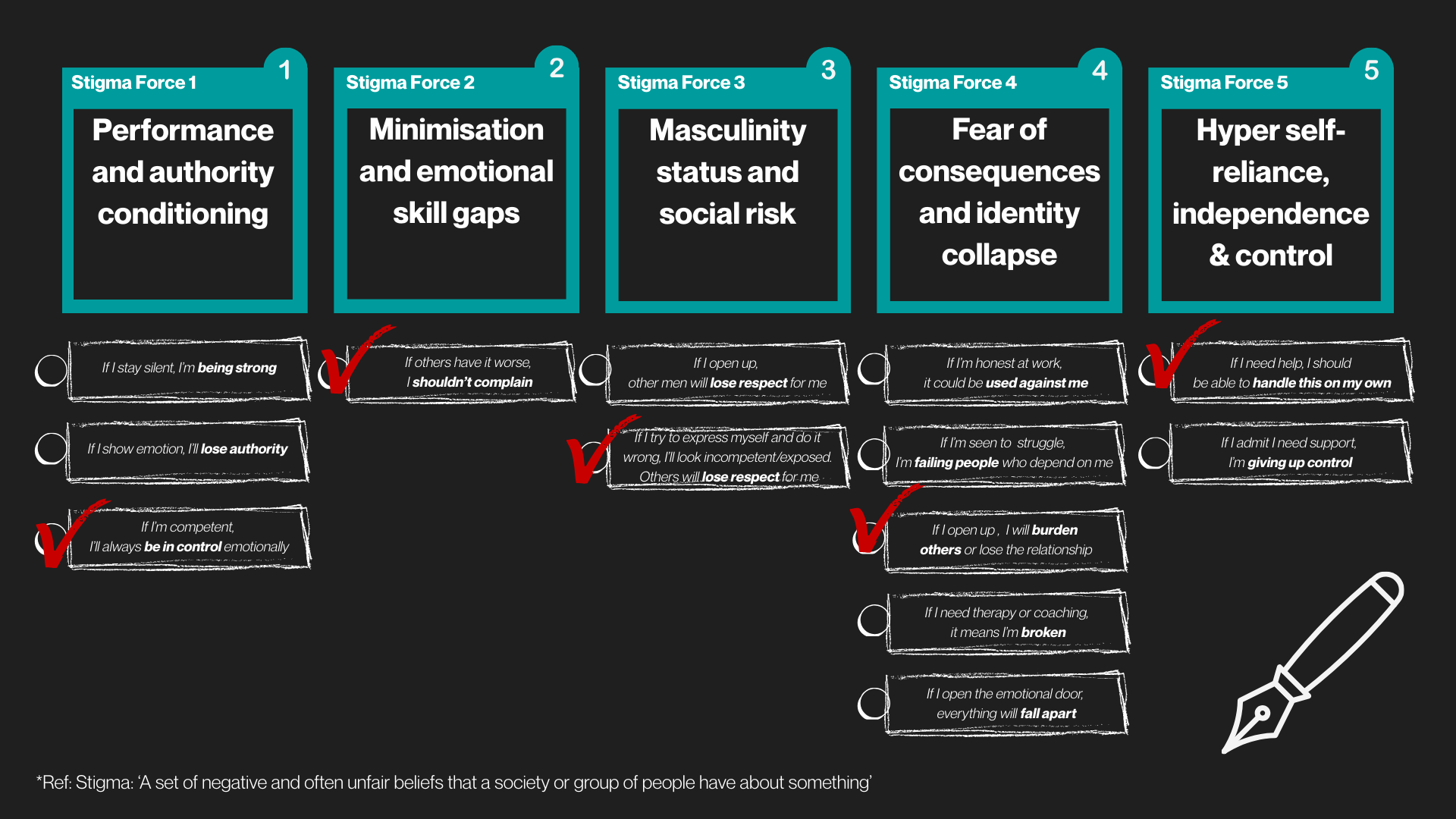
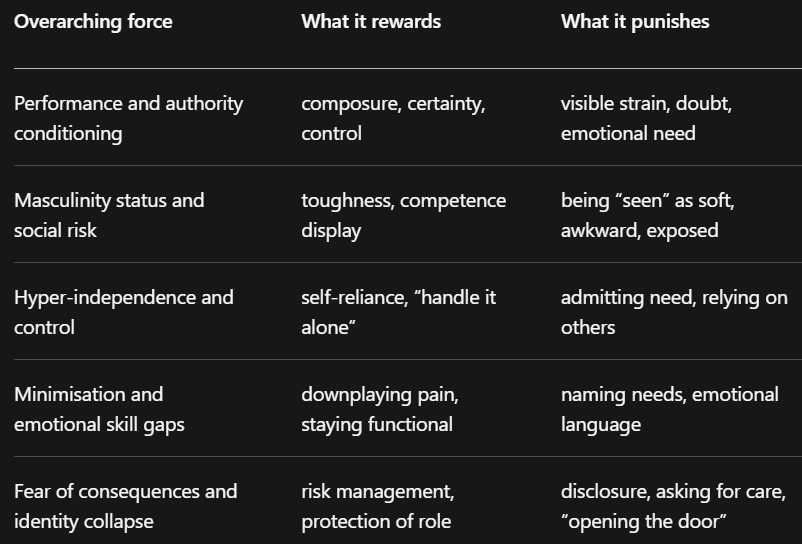
Force 1: Performance & Authority Conditioning
Where expression is suppressed to protect credibility, competence, and leadership image.
Stigma #1. If I stay silent, I’m being strong
Many men grow up learning to “just deal with things.” Silence under pressure is rewarded as maturity and reliability with leaders who don’t flinch given more responsibility. This reinforces the belief that strength equals containment.
Psychologically, this conditions restrictive emotionality (Addis & Mahalik, 2003). Over time, silence stops being a choice and becomes automatic. Beneath it often sits shame as a core belief: If I express what’s really happening, something about me is inadequate.
Therapeutically, silence is protection as expression once carried risk, so your system shut it down. This may take shape in the body through stress responses that activate but never resolve. The nervous system remains in prolonged sympathetic arousal, with tension becoming normalised. Emotionally, unexpressed feelings compress - irritability, numbness, or sudden outbursts emerge when capacity is exceeded. Guilt also plays a role here, with many men feeling guilty for having needs when they “should just be coping.”
Supportive reframe
Strength is not silence. Strength is regulated expression under pressure.
One practical step today
Write one sentence about something you carried silently today or this week. No fixing, just naming.
Stigma #2. If I show emotion, I’ll lose authority
Many workplaces still equate authority with certainty and emotional neutrality. Expression is therefore quietly penalised.
Psychologically, emotion becomes equated with instability. This is reinforced by shame-based beliefs: If I’m emotional, I’m unprofessional. But research contradicts this, with leaders who show appropriate vulnerability increasing trust and learning (Edmondson, 2018), and emotional intelligence shown to correlate with leadership effectiveness (Goleman et al., 2013).
This creates role captivity. The leadership identity becomes something you must perform, not inhabit. In the body, holding incongruence between felt experience and outward expression drains energy and presence. Emotionally, fear of exposure dominates and guilt often appears too: guilt for “rocking the boat.”
Supportive reframe
Authority comes from emotional honesty, not emotional absence.
People trust leaders who can name what’s actually going on and still set direction, not those who pretend nothing’s happening.
One practical step today
Replace certainty with honesty in your next conversation relating to an important task you’re unsure on: “I don’t have full clarity yet, but here’s what I do know...”
Stigma #3. If I’m competent, I should always be in control emotionally
High-performance cultures reward consistency and penalise emotional fluctuation.
Psychologically, emotional suppression becomes confused with professionalism.
Suppression increases physiological stress and damages relationships (Gross & John, 2003). Avoidance also reduces cognitive flexibility (David, 2016). Shame here often appears as I shouldn’t feel this way. Guilt appears as I’m letting people down by not being on top of this. Worth becomes fused with the performance self, and in the body, emotions are bypassed rather than processed which keeps stress active beneath the surface. Emotionally, stress and anxiety leaks out as rigidity, micromanagement, or over-control.
Supportive reframe
Emotions are useful data, not defects to be managed.
One practical step today
Name the physical sensations before naming the story (you might find it’s a little different!)
Force 2: Masculinity, Status, and Social Risk
Where expression feels dangerous because it threatens rank, respect, or belonging.
Stigma #4. If I open up, other men will lose respect for me
In male-dominated environments, unspoken status rules apply. Toughness is rewarded, and vulnerability feels risky.
Psychologically, masculinity is precarious. Research shows manhood is perceived as something that must be continually proven (Vandello & Bosson, 2013). Shame operates as a social emotion here: If I’m seen this way, I’ll lose standing. This triggers a social threat response, and in the body becomes guarding and automatic. Emotionally, fear, shame, and comparison dominate.
Supportive reframe
Respect comes from grounded presence, not toughness theatre.
One practical step today
Reflect for a minute on one truth revealed to you by a man you respect who has chosen to open up, and observe what actually happens.
Stigma #5. If I try to express myself and get it wrong, I’ll look incompetent or exposed
Many men feel too embarrassed to express themselves. The fear isn’t emotion itself, it’s humiliation.
Psychologically, this is shame avoidance. Research on normative male alexithymia shows many men lack emotional vocabulary due to socialisation, not lack of feeling (Levant et al., 2009). The shame belief underneath is If I fumble this, I’ll be exposed. Avoidance protects against embarrassment. In the body, freeze responses dominate and emotionally we show frustration as self-criticism builds.
Supportive reframe
Expression is a trainable skill, not a personal failing.
One practical step today
Share one uncomfortable feeling with someone you trust today, using simple language. Clumsy is allowed, watch what happens.
With repetition, you’ll quickly see no one judges or cares, and usually wants to help!
Force 3: Hyper self-reliance, independence and control
Where coping alone becomes a survival strategy.
Stigma #6. If I need help, I should be able to handle this on my own
Many men learn early to “just deal with it.” Over time, this becomes identity.
Psychologically, self-reliance is moralised. Men who endorse strong self-reliance are significantly less likely to seek help (Vogel et al., 2011). Shame shows up as I shouldn’t need this. Guilt shows up as I’m burdening others. This reflects avoidant coping.
In the body, stress is carried alone, leading to fatigue and shutdown.
Emotionally, loneliness and quiet resentment build.
Many men eventually report having no one they feel safe talking to.
Supportive reframe
Elite performance is inter-dependent. There is a place for both independence and co-dependence when both performing and building a fulfilling life.
One practical step today
Say one unresolved pressure out loud to someone safe, without asking them to fix it. See how it feels to have someone lean in…
Stigma #7. If I ask for help, I’m giving up control
Leadership amplifies responsibility, reinforcing the need to stay in control.
Psychologically, autonomy becomes equated with safety. Men often associate help-seeking with loss of control (Biddle et al., 2012).
Shame here is subtle: Needing help means I’m not enough.
Guilt appears as I should be able to carry this.
Hyper-independence becomes self-protection and in the body, hypervigilance dominates. Emotionally, guardedness and distrust increase.
Supportive reframe
Expression restores agency, with asking for help when needed being an expression of ultimate control.
Suppression removes it.
One practical step today
Ask for input on something small and notice the outcome.
Force 4: Minimisation, and Skill Gaps
Where men downplay their experience or lack language to express it.
Stigma #8. If others have it worse, I shouldn’t complain
Success narratives discourage acknowledging cost.
Psychologically, this is emotional minimisation. Shame says my pain isn’t legitimate. Guilt says I don’t deserve support.
Burnout research shows this delay is costly (Maslach & Leiter, 2016; Mind UK, 2023). Experience is dismissed before it can be processed, and in the body, stress accumulates. Emotionally, exhaustion and guilt coexist.
Supportive reframe
Expression is preventative maintenance.
One practical step today
Name one cost of ‘success’ without qualifying it.
Force 5: Fear of Consequences and Identity Collapse
Where expression feels like it could cost safety, role, or belonging.
Stigma #9. If I’m honest at work, it could be used against me
Surveillance cultures amplify threat perception.
Psychologically, shame and fear blend into hyper-caution. Expression feels dangerous, and guarded attachment patterns emerge.
In the body, armouring replaces regulation, and anxiety and withdrawal can dominate.
Supportive reframe
Expression requires discernment, not oversharing.
One practical step today
Choose one safe context to speak honestly, as much as you feel comfortable.
Stigma #10. If I struggle, I’m failing those who depend on me
Provision across our lives can be tightly linked to worth for many men.
Psychologically, shame appears as I’m not enough. Guilt appears as I’m letting people down. Gender role conflict research links this to distress (O’Neil, 2008). Self-care feels selfish.
The body can experience chronic overdrive that leads to depletion.
Emotionally, fear and pressure dominate.
Supportive reframe
Expression protects your capacity to provide, as we retain our vitality.
One practical step today
Name one limit you’re ignoring that might affect those who depend on you, and how you could test it.
Stigma #11. If I open up in my relationship, I’ll burden or lose my partner
Many men learn early that emotions threaten connection.
Psychologically, vulnerability becomes associated with rejection. Shame appears as I’m too much. Guilt appears as I shouldn’t put this on them.
Emotional withdrawal predicts relational decline (Gottman Institute) and avoidant intimacy patterns form with closeness triggering threat.
Emotionally, longing and distance coexist.
Supportive reframe
Expression with ownership and integrity builds intimacy, whilst lightening the burden.
One practical step today
Lean a little over your edge, and share one feeling with daring authenticity that you’ve been holding back WITHOUT asking for solutions.
Stigma #12. If I need coaching, therapy or counselling, I must already be broken
Support is framed as remedial rather than developmental.
Psychologically, identity mismatch blocks access. Men avoid support that threatens masculine identity (Seidler et al., 2016), and shame dominates here.
Stigma becomes internalised, and sadly seeking help triggers threat. We can become defensive and resistance appears.
Supportive reframe
Expression work is leadership development.
One practical step today
Ask: “What skill would I train if this were about performance?”
Stigma #13. If I open the door emotionally, everything might fall apart
Years of suppression amplify fear.
Psychologically, experiential avoidance increases distress over time (Hayes et al., 2011). Shame says what’s inside me is too much. The system fears overwhelm and the body’s freeze response dominates.
Emotionally, dread and avoidance persist.
Supportive reframe
Expression integrates identity. Suppression fragments it.
Think of the cycle: Order, Disorder, Reorder. Suppression keeps you in disorder!
One practical step today
If you don’t already, share one small but difficult emotional truth with someone in your team you trust, not needing the whole story.
How these stigmas compound over time…
These stigmas don’t act alone, like everything they stack.
Embarrassment discourages early expression. Learning to “just deal with it” reinforces silence. Avoiding admission of needing support deepens isolation. Over time, relationships thin out.
Eventually, many men reach a point where they genuinely feel they have no one to talk to.
At that stage, the Expression Gap is no longer just emotional. It is relational, existential, and embodied.
Why vulnerability matters!
Vulnerability is not self-disclosure for its own sake. It is the mechanism through which shame dissolves, meaning forms, connection deepens, and engagement returns.
Research on wholehearted living (see any book by Brene Brown for more on this) consistently links vulnerability with:
Greater meaning and purpose
Stronger relationships
Higher engagement and vitality
Psychological flexibility and resilience
Without vulnerability, life becomes efficient but empty.
With it, expression becomes the bridge back to wholeness, aliveness, and belonging.
That is why these reframes matter, not to make men ‘softer’ but in fact to help make them whole, connected, and fully alive.