

Authenticity: the often missing link in modern male leadership.
“To thine own self be true, and it must follow, as the night the day, thou cans’t not be false to any man.” —Shakespeare, Hamlet
We hear it everywhere: “Be yourself.” “Be authentic.” “Speak your truth.”
- let’s face it, it can be the most useless ‘advice’ anyone can receive, in isolation that is.
But very few people actually understand what authenticity is, and its relationship to self-expression. In not understanding this, it will only hinder attempts for the modern man to develop into their own most integrated, powerful and full expressed self as a man and a leader, to serve others, have maximum healthy impact and tap into their full potential.
The real problem is not that men lack authenticity, it’s that authenticity remains trapped internally, unable to be expressed.
Authenticity vs. Self-expression
Authenticity and self-expression are deeply connected, but they are not identical.
Authenticity = Alignment with the “true self”
It refers to the degree to which a particular behavior is congruent (in agreement or harmony) with a person’s attitudes, beliefs, values, motives, and other dispositions.
Self-expression = Enactment and communication of that true self
Self-expression is the behavioural mechanism that reveals how aligned you are to your authentic self.
Research consistently supports this self-congruency principle. When individuals behave in ways that align with their true self-concept, they experience authenticity. When behaviour contradicts their self-concept, they experience inauthenticity*.
Authenticity is not just a belief, it is a lived behavioural state.
[Trying to] Define Authenticity
As the term is typically used, authenticity refers to the degree to which a particular behavior is congruent with a person’s attitudes, beliefs, values, motives, and other dispositions.
However, researchers disagree regarding the best way to conceptualize and measure authenticity, whether being authentic is always desirable, why people are motivated to be authentic, and the nature of the relationship between authenticity and psychological well-being.
There are 4 broad categories of authenticity as a field:
Self-congruence (internal psychological alignment angle)
At the core of authenticity research is something called self-congruency.
This is further broken down into different self-congruence concepts such as:
Congruence with the “true self” inner identity- a person’s “actual physiological states, emotions, and beliefs” (Wood, Linley et al) e.g. “I was my true self during the last 10 minutes”
Congruence with beliefs, attitudes, or values (which can, but not always, result in integrity when acting in accordance with our values or morals)
Cross-cultural and cross-role consistency (the degree to which people’s behavior varies across situations or social roles) - There is an assumption that people who act congruently with how they really are necessarily demonstrate greater consistency across situations, although this is not always the case.
2. Person-centered approach (the human and social angle - see figure below)
Born out of therapeutic evidence that individuals progressed better when: responding authentically, distancing themselves from societal expectations, letting go of externally motivated goals, and revealing their true selves to close others*.
Maslow (1971) suggested that, to be authentic, people must discover their true identity, allow their behavior to be a true and spontaneous expression of their feelings, and live in a way that expresses their actual characteristics and desires.
The person-centered approach was advanced upon by Barrett-Lennard (1998), suggesting that authenticity involves congruence among three components of psychological functioning:
internal experience
awareness of experience
external behavior.
The more that people are aware of their inner experiences and then behave in ways that are congruent with those experiences, the more authentic they are. Like Rogers (1959), Barrett-Lennard argued that people are authentic when their internal experience and behavior are free of outside influences and other people’s expectations.
3. Intrinsically Motivated Behavior (the inner motive angle)
According to self-determination theory, human beings inherently value acting congruently with their intrinsic motives but differ in the degree to which they actually do so (Ryan, 1995; Ryan & Deci, 2004). The theory maintains that the most autonomous or authentic source of motivation is intrinsic motivation—a desire to engage in behaviors because they are inherently enjoyable or interesting.
The theory states that people are most authentic when they are intrinsically motivated.
From the self-determination perspective, authenticity can be assessed by determining the degree to which people choose to behave in a particular way for intrinsic reasons rather than because of external pressures.
This is contrasted with 4 types of extrinsic motivation:
external regulated behaviour (due to external incentives only)
introjected regulation of behaviour (enactment to protect one’s ego and avoid negative emotions without internalising the behaviour as part of one’s self concept)
regulation through identification (consciously placing personal importance on a goal even though the reasons for pursuing it are external)
integrated regulation (when a goal is completely integrated with one’s self concept but is not intrinsically motivating or interesting)*.
4. Subjective Feelings of Authenticity (the experiential/felt angle)
Researchers sometimes conceptualize authenticity experientially, focusing on people’s subjective feelings of self-congruence or authenticity.
e.g. describing a past event during which they felt most like their true or real self, how often then feel they are themselves or not etc.
Whichever conceptualisation you favour, when your actions contradict your internal identity, you experience fragmentation.
Hence why authenticity feels like relief, and inauthenticity feels like tension. It reflects a real psychological conflict between internal identity and external behaviour.
Cognitive consistency theory explains this well. Humans are driven to maintain alignment between beliefs, identity, and behaviour. When these become misaligned, psychological discomfort emerges*.
In other words, authenticity is psychological coherence. Self-expression is how coherence is achieved.
Subjective feelings of one’s authenticity and inauthenticity are an interesting and potentially important phenomenon in their own right, but such feelings do not necessarily reflect how authentic people actually are. People quite often just don’t know what they are like, or why they do what they do (Bargh et al.).
Some scholars have disputed that people possess a “true self” at all, although most agree that people’s beliefs about the true self are important for finding fulfillment and meaning in life. The human personality has a myriad of personality dispositions, emotional tendencies, values, attitudes, beliefs, and motives that are often contradictory and incompatible even though they are genuine.
In fact, Fleeson studied this in 2004, and found that intrapersonal variability on many traits is as great as the variability observed across people . Two seemingly incompatible actions might both be highly self-congruent. People are simply too complex, multifaceted, and often conflicted for the concept of a unitary true self to be a useful standard for assessing authenticity, either in oneself or in others (James, 1890)*.
Authenticity isn’t just behaviour, it’s a Psychological System.
Authenticity is not simply “saying what you feel.” It is a deeper psychological process involving multiple components.
Kernis and Goldman’s foundational model identifies four core elements of authentic functioning:
• Self-awareness - to have self-awareness is to possess self-knowledge
• Unbiased self-evaluation (aka. honesty)
• Behaviour aligned with internal values (aka. expressing the self)
• Relational openness and honesty* (aka. relationship transparency)
In order to strive for authenticity and to know whether they are being authentic, people must know what they are actually like.
People usually think that they have a good idea of who they are, what they are like, and why they do what they do, but all indications suggest that people’s self-perceptions are partial, selective, and biased (Vazire & Carlson, 2010). And if people are not and cannot be aware of what causes them to act as they do, then they cannot possibly know whether a particular reaction is “really them.”.
We need to keep in mind that much of what people believe about themselves is incomplete, biased, or untrue (Vazire & Carlson, 2010), so we should not be so confident and sure that an action of ours is or is not congruent with our personal characteristics, attitudes, beliefs, values, and motives.
In the research whitepaper acting as critical study on authenticity entitled: ‘The Enigma of being yourself’, the researchers’ view was that: ‘admonitions to be authentic make sense only if people have full and accurate knowledge about themselves and, thus, know when they are and are not being authentic. Given that people do not have the requisite self-knowledge and feelings cannot be trusted, requiring accurate self-perceptions as a precondition for authenticity is highly problematic.’
Even so, our subjective judgments of our authenticity (“subjective authenticity”) is still an important topic in its own right because people’s emotions and behaviors are affected by their perceptions of their authenticity, whether or not they’re accurate.
Types of Authenticity
Firstly, there are different types of authenticity researched and referenced in the literature. Primarily, state authenticity and dispositional authenticity.
State Authenticity
State authenticity refers to the moment-to-moment feeling of being aligned with one’s true self*.
Disposition (trait) authenticity
Trait authenticity is a stable tendency to behave in ways that align with core values, beliefs and identity across time.
Relational Authenticity
We can also define a third type, called relational authenticity.
This encapsulates the degree to which we are open, honest and congruent within close relationships.
Other types of authenticity and related descriptors are sometimes referenced such as existential authenticity (living in alignment with freely chosen values despite social pressure), behavioural authenticity (which is more embedded in self congruence frameworks as opposed to a distinct type), perceived authenticity (how authentic others perceive someone) and moral authenticity (where research distinguishes between authenticity and integrity, given someone can be authentic and lack integrity and vice versa).
Authenticity isn’t fixed, it’s a dynamic state.
Authenticity is not a permanent trait, it fluctuates depending on context and behaviour.
You can feel authentic in one environment, and inauthentic in another. This explains why many men feel fully themselves with close friends, but restricted at work.
It is not because their authentic self disappears. It is because the conditions required for authentic expression are absent.
People assume authenticity is consistency in that people who behave congruently with how they really are naturally behave quite similarly across situations and roles. Yet, equating consistency with authenticity is based on one of two unfounded assumptions:
either people have a monolithic, internally consistent personality - Unlikely!
or they possess a psychological mechanism that somehow coordinates all of their actions to render them consistent. That would be nice!
Behaviour has a large amount of variability and inconsistency and is situation dependent. Behaving inconsistently does not imply people are not behaving congruently with how they really are. In fact, behavior to meet situational demands (often called “functional flexibility”) is, within limits, psychologically and socially adaptive and that behavioral invariance can be a sign of maladaptive inflexibility (Funder & Colvin, 1991).
One area of my coaching work focuses on supporting male leaders to express themselves consistently with who they are in that moment through creating safe containers and environments, as opposed to assuming a fixed inner identity that they must consistently remind themselves of and align with no matter when or where, as well as supporting them in aligning with who they believe they are and want to become as trait authenticity. Coaching at a state of being can have the greatest transformation impact over other forms such as transactional (goal-based) coaching which is quickly becoming handled by AI personal coaches.
But here’s the bottom line…
Authenticity depends on expression > Expression depends on safety > Safety depends on environment.
This is where most relational and leadership environments fail.
Authenticity does not require perfect consistency, at its root it requires honesty. Authenticity is not about being one thing all the time, it is about not pretending to be something you are not.
Authenticity is not perfection, it is alignment - whether in the present or as a reflection of overall identity of who you are and want to be.
To explain it another way, I’d like to share a concept in Taoism…
They have a concept called Wu Wei (effortless action or non-doing) which signifies aligning actions with the natural flow of life rather than forcing outcomes. By practicing Wu Wei, individuals can align themselves with the natural rhythms of the universe and find harmony in their actions.
It’s about finding equilibrium when it is lost. It is about being still in motion, accepting change, and living simply. By embracing these principles, individuals can move from one balance point to the next, fostering a deeper sense of tranquility amidst life's complexities.
And we can now measure it.
In The Authentic Personality: A Theoretical and Empirical Conceptualization, researchers set out to develop a reliable Authenticity Scale as a measure of dispositional trait authenticity and tests whether authenticity is related to well-being, as predicted by several counseling psychology perspectives.
In developing a scale of dispositional authenticity, there was a need for a clear definition of the construct, both for item development and to interpret the existing literature. Fortunately, such a definition emerges from person-centered psychology, where substantial debate and conceptualization has led to a clear explanation of the construct, with consensus on the content and boundaries of authenticity (see Wyatt, 2001). The person-centered model mentioned above defines authenticity as a tripartite construct defined by Barrett-Lennard (1998, p. 82) as involving:
“consistency between the three levels of:
(a) a person’s primary experience
(b) their symbolized awareness
(c) their outward behavior and communication”
The researchers focused on the person-centered definition of authenticity simply because it appears to provide the widest and most comprehensive explanation of the construct. This seems to agree with various counseling, clinical, and empirical perspectives, with each conception of authenticity mapping on one or more of the lines as illustrated in the attached figure below.
Scales were designed to measure the tripartite conception of authenticity, comprising self-alienation, authentic living, and accepting external influence.
The scale demonstrated authenticity was strongly related to self-esteem and aspects of both subjective and psychological well-being. In many mainstream counseling psychology perspectives, authenticity is seen as the most fundamental aspect of well-being (Horney, 1951; May, 1981; Rogers, 1961; Winnicott, 1965; Yalom, 1980). These researchers see authenticity not simply as an aspect or precursor to well-being but rather the very essence of well-being and healthy functioning. As such, departures from authenticity are seen as involving increasing psychopathology.
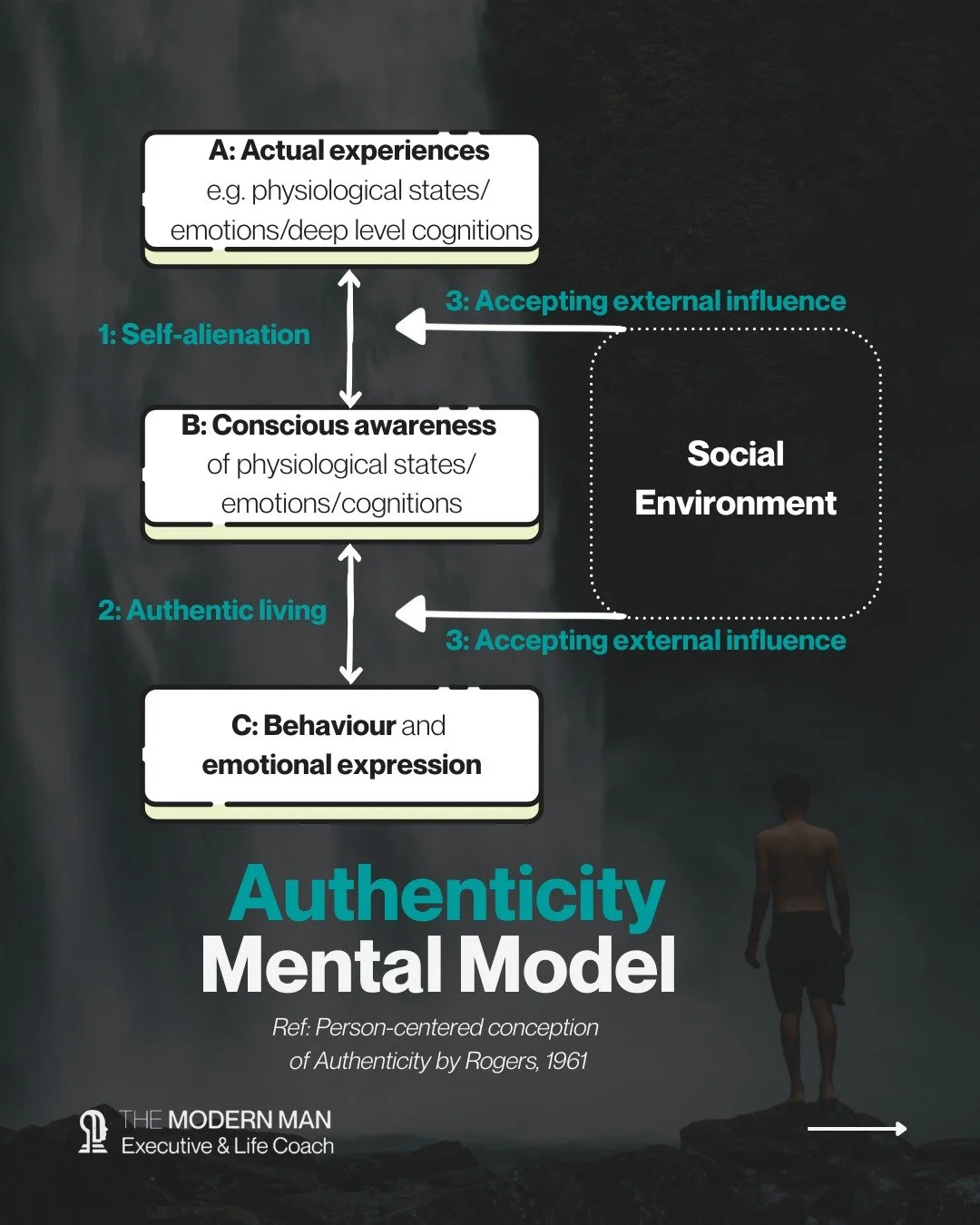
Self-alienation
The first aspect of authenticity involves the inevitable mismatch between the conscious awareness and actual experience.
Perfect congruence between these aspects of experience is never possible, and the extent to which the person experiences self-alienation between conscious awareness and actual experience (the true self) composes the first aspect of authenticity and leads to psychopathology. The subjective experience of not knowing oneself, or feeling out of touch with the true self, is indicative of this aspect of authenticity.
Focusing on internalizing external influence, particularly during childhood, leads to self-alienation. Selfalienation was in turn seen to be the cause of psychopathology as well as mental distress. Even PTSD has been conceptualised as a shattered inauthentic self, and linked its distress with bringing self-alienation to awareness.
Authentic Living
The second aspect of authenticity involves the congruence between experience as consciously perceived (Box B) and behavior (Box C; Rogers, 1959, 1961). Authentic living involves behaving and expressing emotions in such a way that is consistent with the conscious awareness of physiological states, emotions, beliefs, and cognitions.
In other words, authentic living involves being true to oneself in most situations and living in accordance with one’s values and beliefs.
Social environment: Conscious conformance, and accepting external influence
The third aspect of authenticity involves the extent to which one accepts the influence of other people and the belief that one has to conform to the expectations of others. Humans are fundamentally social beings, and both self-alienation and authentic living are affected by the social environment (Schmid, 2005).
The cost of suppressing self-expression
When authentic self-expression is suppressed, psychological fragmentation emerges.
The internal self and external self diverge creating self-alienation.
Historically, this phenomenon has been described as false-self behaviour, where we can act in ways that conceal one’s true internal experience in order to conform to social expectations.
This is not rare, and in most cases is normalised. It is particularly prevalent among men and male leaders who are under pressure to perform, often.
This can lead to feeling numb, lonely or disconnected and if left unattended result in mental health challenges or worse.
Why this matters
From an early age, men are conditioned to regulate expression.
Be strong. Be composed. Be in control - Do not show weakness.
This conditioning teaches behavioural suppression, not authenticity.
Men learn to manage perception rather than express reality.
Over time, this creates a widening gap between internal identity and external behaviour. This is the Expression Gap.
It is not that men lack depth, It is that expression has been constrained.
The consequence is profound. When leaders cannot express their internal reality, they become psychologically divided.
They operate through performance rather than presence.
They lead through persona rather than self. And people can feel the difference immediately.
Trust is built through authenticity. Authenticity is built through expression.
Expression is built through psychological safety and courage.
Authenticity is often misunderstood as vulnerability alone. It is not. It is structural integrity between your identity and behaviour.
It creates:
• Psychological coherence
• Emotional stability
• Relational trust
• Leadership presence
• Internal clarity
Authenticity reduces internal conflict, increases decisiveness and strengthens leadership.
Because when behaviour aligns with identity, energy is no longer wasted on maintaining masks.
All energy becomes available for creation, leadership, and impact.
Authenticity isn’t found, it’s enacted.
Authenticity is not something you discover once and permanently possess. It is something you enact repeatedly.
Through expression, through behaviour, through choices.
Every moment presents the opportunity to either reinforce or fragment alignment.
Authenticity is not a personality trait, it is a behavioural practice.
In should be noted that, in many ways, authenticity is inevitable. Any intentional and goal-directed behaviour will always reflect some genuine characteristic and therefore have some aspect of authenticity. But we can elevate that to a greater extent.
Behaviours differ in their level of alignment with someone’s characteristics, some more self-congruent (and authentic) than others. The degree to which we are self congruent and authentic as opposed to perceived to be, will always be hard to measure.
The leadership divide
The divide in modern leadership is not between strong and weak leaders. It is between expressed and unexpressed leaders.
The most trusted leaders are not those who perform perfectly, they are those whose internal identity and external behaviour are aligned. They seem composed, real, engaged, and people trust that alignment. They distrust what just seems like performance.
Authenticity signals alignment, self-expression makes it visible.
Final Thought
Contemporary perspectives often assume authenticity is beneficial uniformerly across all areas, without recognizing that behaving congruently with one’s undesirable attitudes, beliefs, values, motives, and other characteristics can be highly problematic.
In order for civilized society to function, people must restrain impulses that might hurt themselves or others no matter how genuine and self-congruent those urges might be.
Authenticity is therefore always a part-mitigated value because we do not want people to behave congruently with their antisocial attitudes, motives, and other characteristics.
Although existing conceptualizations of authenticity are problematic in the ways we described, something like subjective authenticity does seem to exist phenomenologically. People do feel authentic and inauthentic at times. Research suggests that self-rated authenticity is associated with well-being, suggesting that the phenomenon that people call “authenticity” is psychologically meaningful but perhaps misconstrued.
Authenticity begins internally with awareness, getting to know oneself. Self-expression completes it externally.
Without authenticity, expression becomes performance.
Without expression, authenticity becomes trapped potential.
We must be aware of and accept our social environment, find intrinsic motivation and not overly conform to external people or drivers.
Leadership begins at the point where authenticity becomes expressed, and we can master expression as a skill to reap the wellbeing and psychological rewards in building a greater sense of authenticity.
References:
The Enigma of Being Yourself: A Critical Examination of the Concept of Authenticity. Katrina P. Jongman-Sereno and Mark R. Leary
The Authentic Personality: A Theoretical and Empirical Conceptualization and the Development of the Authenticity Scale
MULTICOMPONENT CONCEPTUALIZATION OF AUTHENTICITY: THEORY AND RESEARCH Michael H. Kernis, Brian M. Goldman
Refining the self-congruency hypothesis of state authenticity: A self-threat model. Carolin Huber
