

13 Stigmas that stop men and male leaders from expressing themselves.
Many male leaders and professionals like you don’t struggle because they are incapable of expression, it’s more because you learned that expression came with consequences. It is not that men do not feel, it is that many are socialised into norms that make feeling and sharing costly.
Over time, such consequences and their accompanying lessons hardened into internal rules. Rules that shape behaviour long after the original environment has changed.
As we know, at the core of many of these rules sit shame and guilt.
Shame - a core belief about who I am if I’m seen, as well as the shame emotion (eg. “I AM a let down”)
Guilt - a belief about what I’m doing wrong if I inconvenience or fail others, as well as similarly acting as an emotional complex (eg. “I HAVE just let someone down”)
These rules create what I call the Expression Gap: the widening distance between what is happening inside and what is allowed to be expressed, shared, or integrated. If you have been following my work already, you’’ll have no doubt picked up that I use The Expression Gap as a working label for the widening distance between (a) what is happening and arising internally (anything from emotions or states like stress, fear, shame, sadness, uncertainty, overwhelm through, through to other facets or capabilities like creativity, complex ideas, morals/ethics etc etc) and (b) what a man feels permitted or safe to express, process, and ask support for. This Gap can often be amplified by leadership-role expectations and organisational cultures that reward control and penalise visibly displaying such parts of ourselves if not obviously a necessity.
After some research, I’ve structured a set of 13 specific stigmas (that are the rules so many of us adopt consciously or unconsciously), each elaborated through five thematic lenses that may bring some light to some of the forces at work that add friction or prevent us from expressing ourselves to the fullest. These Stigmas are best understood as expressions of five interacting forces that make vulnerability socially expensive for men, especially in leadership.
Reflect on an area of your life where you are struggling to understand what to do, and how to express what’s arising within you, and see if you can relate to one or more of these stigmas right now…
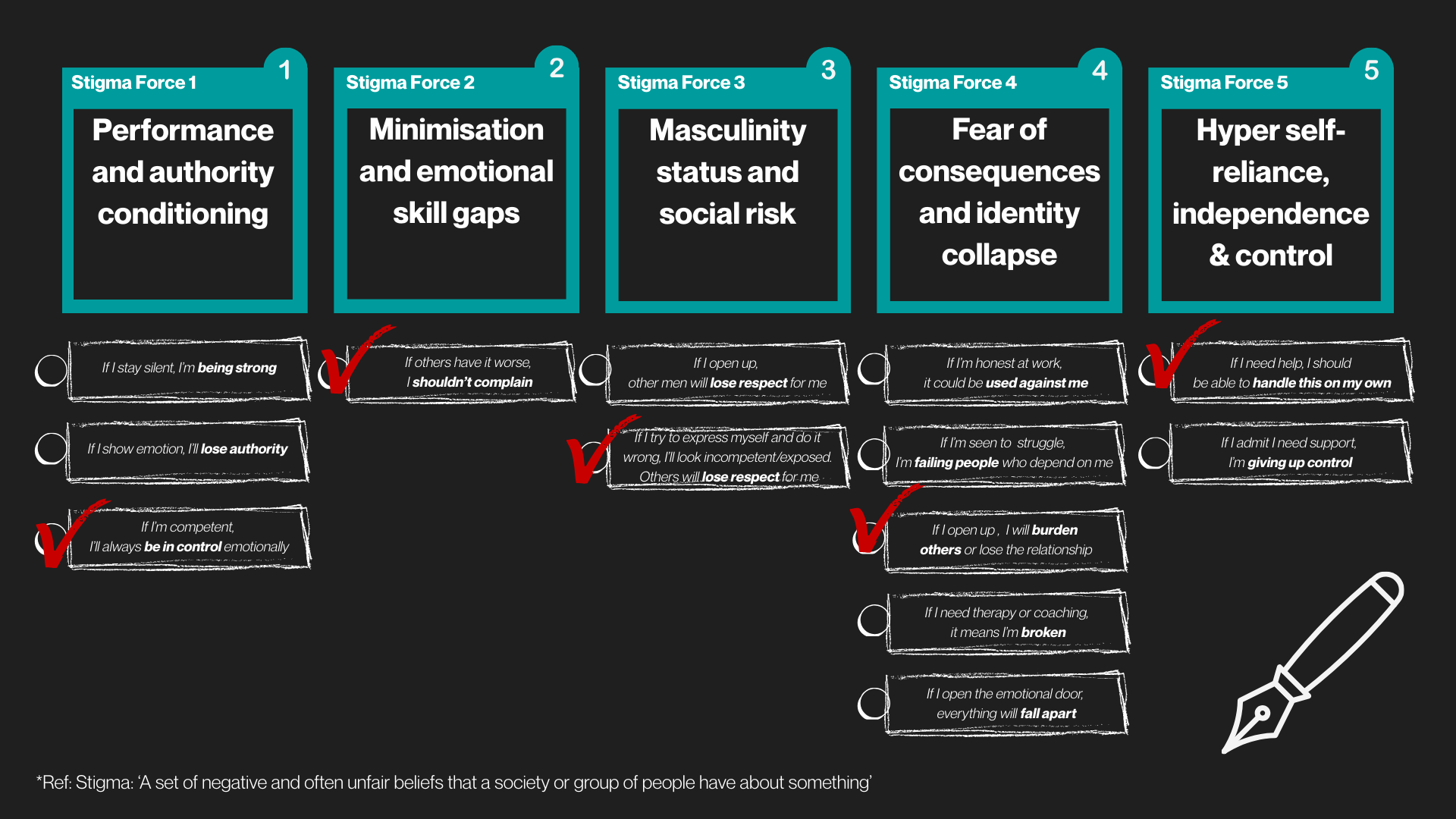
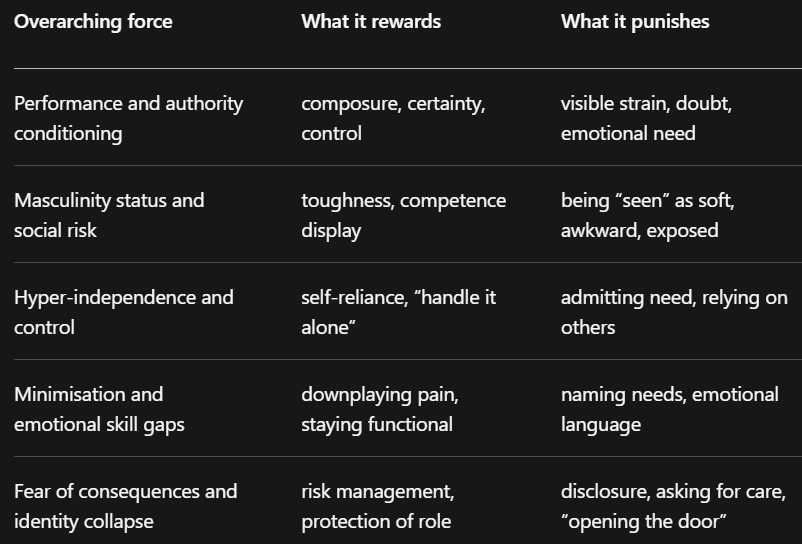
Force 1: Performance & Authority Conditioning
Where expression is suppressed to protect credibility, competence, and leadership image.
Stigma #1. If I stay silent, I’m being strong
Many men grow up learning to “just deal with things.” Silence under pressure is rewarded as maturity and reliability with leaders who don’t flinch given more responsibility. This reinforces the belief that strength equals containment.
Psychologically, this conditions restrictive emotionality (Addis & Mahalik, 2003). Over time, silence stops being a choice and becomes automatic. Beneath it often sits shame as a core belief: If I express what’s really happening, something about me is inadequate.
Therapeutically, silence is protection as expression once carried risk, so your system shut it down. This may take shape in the body through stress responses that activate but never resolve. The nervous system remains in prolonged sympathetic arousal, with tension becoming normalised. Emotionally, unexpressed feelings compress - irritability, numbness, or sudden outbursts emerge when capacity is exceeded. Guilt also plays a role here, with many men feeling guilty for having needs when they “should just be coping.”
Supportive reframe
Strength is not silence. Strength is regulated expression under pressure.
One practical step today
Write one sentence about something you carried silently today or this week. No fixing, just naming.
Stigma #2. If I show emotion, I’ll lose authority
Many workplaces still equate authority with certainty and emotional neutrality. Expression is therefore quietly penalised.
Psychologically, emotion becomes equated with instability. This is reinforced by shame-based beliefs: If I’m emotional, I’m unprofessional. But research contradicts this, with leaders who show appropriate vulnerability increasing trust and learning (Edmondson, 2018), and emotional intelligence shown to correlate with leadership effectiveness (Goleman et al., 2013).
This creates role captivity. The leadership identity becomes something you must perform, not inhabit. In the body, holding incongruence between felt experience and outward expression drains energy and presence. Emotionally, fear of exposure dominates and guilt often appears too: guilt for “rocking the boat.”
Supportive reframe
Authority comes from emotional honesty, not emotional absence.
People trust leaders who can name what’s actually going on and still set direction, not those who pretend nothing’s happening.
One practical step today
Replace certainty with honesty in your next conversation relating to an important task you’re unsure on: “I don’t have full clarity yet, but here’s what I do know...”
Stigma #3. If I’m competent, I should always be in control emotionally
High-performance cultures reward consistency and penalise emotional fluctuation.
Psychologically, emotional suppression becomes confused with professionalism.
Suppression increases physiological stress and damages relationships (Gross & John, 2003). Avoidance also reduces cognitive flexibility (David, 2016). Shame here often appears as I shouldn’t feel this way. Guilt appears as I’m letting people down by not being on top of this. Worth becomes fused with the performance self, and in the body, emotions are bypassed rather than processed which keeps stress active beneath the surface. Emotionally, stress and anxiety leaks out as rigidity, micromanagement, or over-control.
Supportive reframe
Emotions are useful data, not defects to be managed.
One practical step today
Name the physical sensations before naming the story (you might find it’s a little different!)
Force 2: Masculinity, Status, and Social Risk
Where expression feels dangerous because it threatens rank, respect, or belonging.
Stigma #4. If I open up, other men will lose respect for me
In male-dominated environments, unspoken status rules apply. Toughness is rewarded, and vulnerability feels risky.
Psychologically, masculinity is precarious. Research shows manhood is perceived as something that must be continually proven (Vandello & Bosson, 2013). Shame operates as a social emotion here: If I’m seen this way, I’ll lose standing. This triggers a social threat response, and in the body becomes guarding and automatic. Emotionally, fear, shame, and comparison dominate.
Supportive reframe
Respect comes from grounded presence, not toughness theatre.
One practical step today
Reflect for a minute on one truth revealed to you by a man you respect who has chosen to open up, and observe what actually happens.
Stigma #5. If I try to express myself and get it wrong, I’ll look incompetent or exposed
Many men feel too embarrassed to express themselves. The fear isn’t emotion itself, it’s humiliation.
Psychologically, this is shame avoidance. Research on normative male alexithymia shows many men lack emotional vocabulary due to socialisation, not lack of feeling (Levant et al., 2009). The shame belief underneath is If I fumble this, I’ll be exposed. Avoidance protects against embarrassment. In the body, freeze responses dominate and emotionally we show frustration as self-criticism builds.
Supportive reframe
Expression is a trainable skill, not a personal failing.
One practical step today
Share one uncomfortable feeling with someone you trust today, using simple language. Clumsy is allowed, watch what happens.
With repetition, you’ll quickly see no one judges or cares, and usually wants to help!
Force 3: Hyper self-reliance, independence and control
Where coping alone becomes a survival strategy.
Stigma #6. If I need help, I should be able to handle this on my own
Many men learn early to “just deal with it.” Over time, this becomes identity.
Psychologically, self-reliance is moralised. Men who endorse strong self-reliance are significantly less likely to seek help (Vogel et al., 2011). Shame shows up as I shouldn’t need this. Guilt shows up as I’m burdening others. This reflects avoidant coping.
In the body, stress is carried alone, leading to fatigue and shutdown.
Emotionally, loneliness and quiet resentment build.
Many men eventually report having no one they feel safe talking to.
Supportive reframe
Elite performance is inter-dependent. There is a place for both independence and co-dependence when both performing and building a fulfilling life.
One practical step today
Say one unresolved pressure out loud to someone safe, without asking them to fix it. See how it feels to have someone lean in…
Stigma #7. If I ask for help, I’m giving up control
Leadership amplifies responsibility, reinforcing the need to stay in control.
Psychologically, autonomy becomes equated with safety. Men often associate help-seeking with loss of control (Biddle et al., 2012).
Shame here is subtle: Needing help means I’m not enough.
Guilt appears as I should be able to carry this.
Hyper-independence becomes self-protection and in the body, hypervigilance dominates. Emotionally, guardedness and distrust increase.
Supportive reframe
Expression restores agency, with asking for help when needed being an expression of ultimate control.
Suppression removes it.
One practical step today
Ask for input on something small and notice the outcome.
Force 4: Minimisation, and Skill Gaps
Where men downplay their experience or lack language to express it.
Stigma #8. If others have it worse, I shouldn’t complain
Success narratives discourage acknowledging cost.
Psychologically, this is emotional minimisation. Shame says my pain isn’t legitimate. Guilt says I don’t deserve support.
Burnout research shows this delay is costly (Maslach & Leiter, 2016; Mind UK, 2023). Experience is dismissed before it can be processed, and in the body, stress accumulates. Emotionally, exhaustion and guilt coexist.
Supportive reframe
Expression is preventative maintenance.
One practical step today
Name one cost of ‘success’ without qualifying it.
Force 5: Fear of Consequences and Identity Collapse
Where expression feels like it could cost safety, role, or belonging.
Stigma #9. If I’m honest at work, it could be used against me
Surveillance cultures amplify threat perception.
Psychologically, shame and fear blend into hyper-caution. Expression feels dangerous, and guarded attachment patterns emerge.
In the body, armouring replaces regulation, and anxiety and withdrawal can dominate.
Supportive reframe
Expression requires discernment, not oversharing.
One practical step today
Choose one safe context to speak honestly, as much as you feel comfortable.
Stigma #10. If I struggle, I’m failing those who depend on me
Provision across our lives can be tightly linked to worth for many men.
Psychologically, shame appears as I’m not enough. Guilt appears as I’m letting people down. Gender role conflict research links this to distress (O’Neil, 2008). Self-care feels selfish.
The body can experience chronic overdrive that leads to depletion.
Emotionally, fear and pressure dominate.
Supportive reframe
Expression protects your capacity to provide, as we retain our vitality.
One practical step today
Name one limit you’re ignoring that might affect those who depend on you, and how you could test it.
Stigma #11. If I open up in my relationship, I’ll burden or lose my partner
Many men learn early that emotions threaten connection.
Psychologically, vulnerability becomes associated with rejection. Shame appears as I’m too much. Guilt appears as I shouldn’t put this on them.
Emotional withdrawal predicts relational decline (Gottman Institute) and avoidant intimacy patterns form with closeness triggering threat.
Emotionally, longing and distance coexist.
Supportive reframe
Expression with ownership and integrity builds intimacy, whilst lightening the burden.
One practical step today
Lean a little over your edge, and share one feeling with daring authenticity that you’ve been holding back WITHOUT asking for solutions.
Stigma #12. If I need coaching, therapy or counselling, I must already be broken
Support is framed as remedial rather than developmental.
Psychologically, identity mismatch blocks access. Men avoid support that threatens masculine identity (Seidler et al., 2016), and shame dominates here.
Stigma becomes internalised, and sadly seeking help triggers threat. We can become defensive and resistance appears.
Supportive reframe
Expression work is leadership development.
One practical step today
Ask: “What skill would I train if this were about performance?”
Stigma #13. If I open the door emotionally, everything might fall apart
Years of suppression amplify fear.
Psychologically, experiential avoidance increases distress over time (Hayes et al., 2011). Shame says what’s inside me is too much. The system fears overwhelm and the body’s freeze response dominates.
Emotionally, dread and avoidance persist.
Supportive reframe
Expression integrates identity. Suppression fragments it.
Think of the cycle: Order, Disorder, Reorder. Suppression keeps you in disorder!
One practical step today
If you don’t already, share one small but difficult emotional truth with someone in your team you trust, not needing the whole story.
How these stigmas compound over time…
These stigmas don’t act alone, like everything they stack.
Embarrassment discourages early expression. Learning to “just deal with it” reinforces silence. Avoiding admission of needing support deepens isolation. Over time, relationships thin out.
Eventually, many men reach a point where they genuinely feel they have no one to talk to.
At that stage, the Expression Gap is no longer just emotional. It is relational, existential, and embodied.
Why vulnerability matters!
Vulnerability is not self-disclosure for its own sake. It is the mechanism through which shame dissolves, meaning forms, connection deepens, and engagement returns.
Research on wholehearted living (see any book by Brene Brown for more on this) consistently links vulnerability with:
Greater meaning and purpose
Stronger relationships
Higher engagement and vitality
Psychological flexibility and resilience
Without vulnerability, life becomes efficient but empty.
With it, expression becomes the bridge back to wholeness, aliveness, and belonging.
That is why these reframes matter, not to make men ‘softer’ but in fact to help make them whole, connected, and fully alive.
