

Authentic Leadership matters
Authentic leadership is a destination that delivers for male leaders.
But most men were never given the road to get there.
There's an awkward admission buried in the academic literature on authentic leadership.
After two decades of research, hundreds of studies, and enough peer-reviewed papers to fill a library shelf, the scholars themselves concede that the field has a problem:
it's very good at proving that authentic leadership matters, and almost silent on how you actually develop it.
Gardner and colleagues' landmark review of 91 authentic leadership publications puts it plainly. The majority of work to date has been theoretical, building and extending models of what authentic leadership is. Empirical studies that test those models in the real world are the minority. Research that focuses specifically on developing authentic leaders? Rarer still. As the authors note, intervention strategies intended to foster authentic leadership development remain largely unevaluated.
This isn't a small gap. It's the gap between knowing a destination exists and having a road or map to get there.
The evidence for why this matters is substantial enough that it deserves more than a passing mention. Across studies reviewed by Gardner and colleagues, authentic leadership has been shown to be positively linked to:
follower trust in leadership,
job satisfaction,
organisational commitment,
work engagement,
job performance,
empowerment,
employee voice,
organisational citizenship behaviour,
performance at the individual, team, and organisational level,
and leader psychological wellbeing.
It is negatively linked to follower burnout and turnover intentions.
These aren't soft relational outcomes, they are the things a rising leader is being measured on. The research also surfaces something less obvious: authentic leaders benefit too.
The contingent self-esteem that comes from performing a version of leadership you don't own, and the psychological cost of sustaining it, is documented.
What the studies describe, is a leader whose people want to stay, work harder, speak up, trust the direction, and follow without being pushed.
That combination doesn't emerge from charisma or authority. According to the research, it emerges from the perception, held consistently by those around the leader, that what they see is real.
What Authentic Leadership (“AL”) actually is
The concept has a surprisingly long genealogy. The word authentic traces to the Greek authento - "to have full power" - and the philosophical tradition that surrounds it, from Socrates' insistence that the unexamined life is not worth living to Aristotle's conception of eudaimonia, a form of wellbeing that arises not from pleasure-seeking but from performing activities that reflect one's true calling.
Erickson (1995) cautions that authenticity should not be conceived as an either/or condition, since people are never completely authentic or inauthentic. Thus, it is more realistic to describe a person as being more or less authentic.
There are many definitions for authenticity that come at it from different angles…
Harter (2002) describes authenticity as owning one’s personal experiences, including one’s thoughts, emotions, needs, desires, or beliefs which involves self-awareness and acting in accord with one’s true self by expressing what one genuinely thinks and believes (Luthans & Avolio, 2003).
The work that has been most instrumental in reigniting scholarly interest in AL is Luthans and Avolio’s conceptualization of AL and its development. As these authors explain, the theoretical underpinnings of their AL model include positive organizational behavior (“POB”) (Luthans, 2002), transformational/full-range leadership (Avolio, 1999), and ethical perspective-taking (Kegan, 1982). Because of this confluence of perspectives, their definition of AL includes POB states such as confidence, hope, optimism, and resilience (“CHOR”) that later became the basis for Luthans’ and associates psychological capital (“PsyCap”) construct.
Modern scholarship took these and wider philosophical heritages and looked to operationalise it…
The most widely cited and empirically validated definition comes from Walumbwa and colleagues (2008), as refined through Gardner's sustained research programme serving as a theoretical foundation for several theories of AL:
“Authentic leadership is a pattern of leader behavior that promotes greater:
a) self-awareness
(self knowledge and understanding i.e. knowledge and trust in one’s thoughts, feelings, motives and values);
b) an internalized moral perspective
(the behaviour/action component i.e. reflecting the leader’s commitment to core ethical values, internalized regulation and a positive moral perspective. Acting based on one’s true preferences, values, and needs rather than merely acting to please others, secure rewards, or avoid punishments);
c) balanced processing of information
(unbiased processing i.e. objectivity about and acceptance of one’s positive and negative attributes);
d) relational transparency on the part of leaders working with followers.
(interpersonal relationship orientation i.e. achieving and valuing truthfulness and openness in one's close relationships; Kernis, 2003;)”
In plain English:
Know yourself.
Know what you stand for.
Process information fairly, especially when it threatens your ego (don’t get defensive!).
Let people see enough of the real you to build trust.
The original Walumbwa definition included references to "positive psychological capacities" and "a positive ethical climate" as conditions the behaviour "draws upon and promotes." Gardner's 2021 recommendation was to strip those phrases out, because positing antecedents and consequences inside a definition creates circular reasoning. What's left is cleaner: a description of the behaviour itself, not its preconditions or its outputs.
So four components, and worth unpacking properly…
Self-awareness is not the same as self-consciousness. In Gardner's framework, it refers to knowledge and trust in one's own motives, goals, values, and emotions, and crucially, the work-related self that gets enacted under the pressures of a role. The self, in this conception, is multi-faceted and dynamic. Leaders have a repertoire of selves across different contexts. Self-awareness is what allows a leader to navigate that repertoire without losing the thread back to their core values.
Relational transparency is not radical self-disclosure. Gardner and colleagues are careful here: it means helping those close to you see both your positive and negative qualities as a basis for genuine trust, while encouraging others to do the same. It also means being transparent about how decisions are made and explained, not performing openness, but actually creating the conditions in which honest exchange is possible. There are legitimate limits. A leader facing an anxious private situation may hold that back during a product launch not because they're being inauthentic, but because doing so serves a higher value: commitment to the organisation's people and direction.
Balanced processing replaces what Kernis originally called "unbiased processing", a deliberate revision, because Gardner's team recognised that all humans are inherently biased. What's being asked for instead is the effort to be objective: staying open to ego-threatening feedback, processing information without defensiveness, actively listening to viewpoints that challenge your own position. Not neutrality, but the sustained attempt to get beyond the distortions of self-interest.
Internalized moral perspective is the most contested of the four. Shamir and Eilam, among others, deliberately avoided including ethics as a component, on the grounds that authentic leadership says nothing about the content of a leader's values. Gardner's response: that's precisely the problem. A leader can be consistently true to values that are harmful. Ethics lies at the heart of leadership because leaders' actions have consequences for others, and development that doesn't attend to moral growth is incomplete. The internalized part matters, this is regulation from the inside, not compliance with external norms.
Together, the four components work on each other.
Self-awareness gives a leader the material to articulate their values to others compellingly. Relational transparency creates the conditions for genuine exchange. Balanced processing keeps that exchange honest rather than defensive. An internalized moral perspective means value conflicts with followers get navigated, not steamrolled.
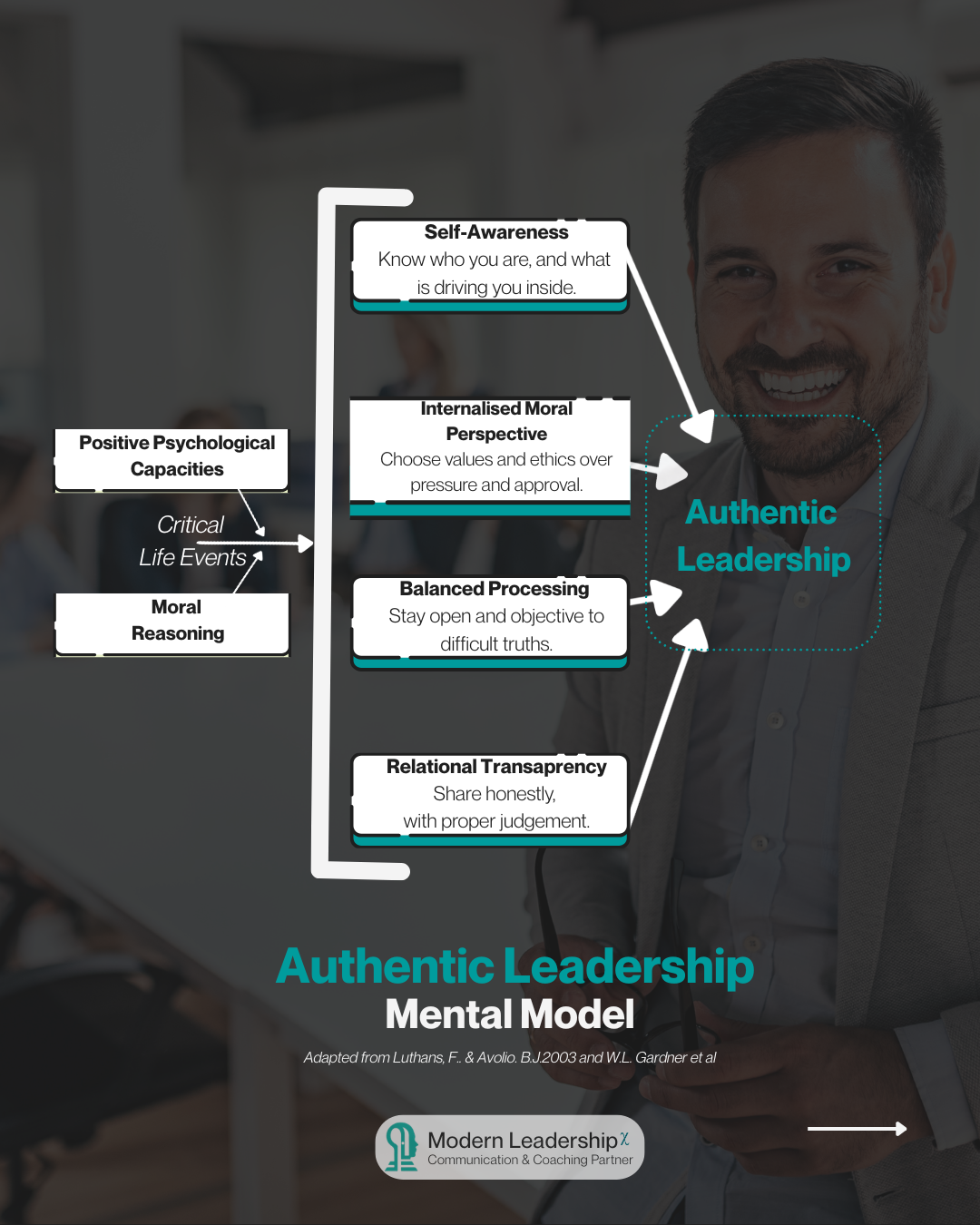
The competing AL interpretations
The four-component model is not the only view of authentic leadership. The debate around it is useful.
Shamir and Eilam take a life-stories approach. For them, authentic leaders are “originals, not copies.” They lead from deeply held values they experience as their own, not values imposed from outside. Their authenticity shows through the fit between who they are, what they believe, and how they act. Development happens through reflecting on life events and the meaning leaders make from them.
Alvesson and Einola push back harder. They argue that leadership studies often treat authenticity as if it were a fixed, measurable thing. But for them, authenticity is more personal, contextual and ongoing. It is not a simple journey from “less authentic” to “more authentic.” They also point out something important: leaders do not have one fixed self. They adapt across roles, audiences and situations. Being rigidly “true to yourself” in every context may not be authenticity. It may just be inflexibility.
Gardner and Karam’s response is the most useful middle ground. Authentic leadership does not ask a leader to perform the same version of himself everywhere. It asks him to navigate different situations without violating the core values that run across who he is. That requires real self-knowledge: strengths, weaknesses, values, goals, motives and emotions.
The most important point is this:
Authenticity is not all or nothing.
Leaders are not simply authentic or inauthentic. They become more or less authentic in different moments, under different pressures.
And we can measure it…
Of the available measures, the ALQ (Authentic Leadership Questionnaire) is grounded in the work by Avolio, Gardner, Luthans, May, Walumbwa et al 2008, and their perspective of AL, which is in turn derived from Kernis and Goldman’s (2006) multi-component conception of authenticity.
This is the most frequently-used measure of AL, while Kernis and Goldman’s Authenticity Inventory (AI: 3) is also available, although this instrument is designed to measure individual authenticity, as opposed to AL.
But this still leaves a practical question:
How does a leader actually get there…?
The Road: how we become an authentic leader
Here is where the literature is most honest about its own limits.
The research has mapped the destination in detail. It has measured the outcomes, validated the instruments, and built the nomological network. What it hasn't done is crack the development question. The authentic leadership literature gives us a strong direction.
It points towards leaders who are more self-aware, morally grounded, open to information, and transparent in relationship with followers. It also links authentic leadership with important outcomes such as trust, engagement, well-being and performance.
However, most male leaders do not struggle because they disagree with the destination.
They struggle because nobody taught them the road.
A man may know his values, but still avoid speaking up.
He may care deeply, but still come across as distant.
He may want to be transparent, but either overshares or says nothing.
He may want to listen, but becomes defensive when challenged.
He may want to lead with integrity, but under pressure defaults to control, performance, approval-seeking or silence.
That is not always a values problem. Often, it is an expression problem.
What the theory does offer are the building blocks…
Authentic leadership, in Gardner's developmental framework, is not a state you arrive at through a course or a retreat. It emerges from a combination of:
personal history - and the meanings a leader attaches to formative events;
trigger events - experiences that provoke self-reflection and interrupt habitual patterns;
psychological capacity - including hope, resilience, optimism, and confidence/self-efficacy (CHOR).
These aren't decorative qualities. They are what allows a leader to stay curious about themselves when self-reflection is uncomfortable, and to stay grounded under pressure rather than defaulting to role.
There is also an organisational dimension. The research is clear that the ethical climate of an organisation either facilitates or undermines the development of authentic leaders and followers. Context matters. A leader striving for authenticity in an environment that punishes genuine expression will obviously face a genuinely harder task than one operating in a culture that values it, and the research supports the view that moving to a different context is sometimes the right call.
But there is also something that context cannot substitute for: the inner work.
This appears to be difficult to reduce to observable behaviours or survey scores. Becoming more authentic in your leadership requires, at minimum:
honest self-examination of the values and motives that actually drive you (not the ones you'd prefer to claim),
the pattern recognition to notice when pressure causes you to abandon them,
and a structured process for integrating who you are into how you lead. Not in safe conditions, but in the moments that count.
The research calls this the gap between felt authenticity and enacted authenticity.
It is real, it is documented, and after two decades of serious scholarly attention, it remains the part of authentic leadership that theory alone cannot bridge just yet.
What this means for a rising male leader
The leaders I work with have usually done the reading. They understand, intellectually, that leading from who they are matters. Some have completed 360s, done the assessments, reflected on their values in a quiet room.
And then one or more high-stakes moments arrive - a difficult conversation, a boardroom, a moment where the environment expects them to perform a version of leadership they recognise but don't quite inhabit - and something shifts. The self they know goes quiet. The mask wearing role takes over. They come out the other side saying that wasn't me and not quite knowing how it happened.
But how do we reliably prevent it?
That, as Gardner's own work concludes, is the work that remains. The science shows it's worth doing. And I’m on a Mission to help us get there…
Here’s a starter for 10:
4 Practices that make authentic leadership real
The academic model gives us four pillars of authentic leadership, and so here’s a question for each pillar you can ask yourself in the moment:
Self-awareness Know what is happening inside you.
Question: What is really going on in me right now?
Internalised moral perspective Choose from values, not pressure.
Question: What would integrity ask of me here?
Balanced processing Stay open to uncomfortable truth.
Question: What might be true, even if I don’t like it?
Relational transparency Express where you stand when it matters.
Question: What needs to be said honestly, but cleanly in a way that lands?
Conclusion
The Psychologist Maslow’s made the point that people are not at peace when they bury what they are here to become.
The same is true in leadership.
A man who is capable of leading cannot fully settle for performing the role while hiding the person that they really are.
Authentic leadership asks him to lead in a way that honours his values, beliefs, strengths and weaknesses. Not as a polished act or a perfect persona, but as a real pattern of behaviour others can experience and trust.
That is where the Expression Gap matters.
Because many male leaders DO know who they are.
They know what they value.
They know what they believe.
They know what needs to be said.
They know the kind of leader they want to become.
But under pressure, the role takes over.
They go guarded, silent, defensive, polished etc.
They perform leadership instead of expressing it.
Authentic leadership gives us the destination:
Self-awareness, moral grounding, balanced thinking and relational transparency.
Our Expression Gaps are the map, with role models that are authentic leaders providing a rough direction to our destination.
Deeper connection with your own authentic leadership is the true destination.
Mastering expression is the road…
To become a leader whose people want to stay, work harder, speak up, trust the direction, and follow without being pushed.
Know yourself.Choose from values.Stay open to truth.Express with integrity.
#leadership #authenticleadership #authenticity #leader
Morgan works with rising male leaders on identity awareness and self-expression - helping them close the gap between who they are and how they show up when stakes are high.
References:
2011 Yearly Review: The Leadership Quarterly: ‘Authentic Leadership: A Review of the Literature and Research Agenda’ (William L. Gardner et al.)
Authentic leadership theory: The case for and against (Gardner Letter responses to critique)
Medtronic CEO Bill George (Authentic Leadership, True North, George and Sims, 2007)
